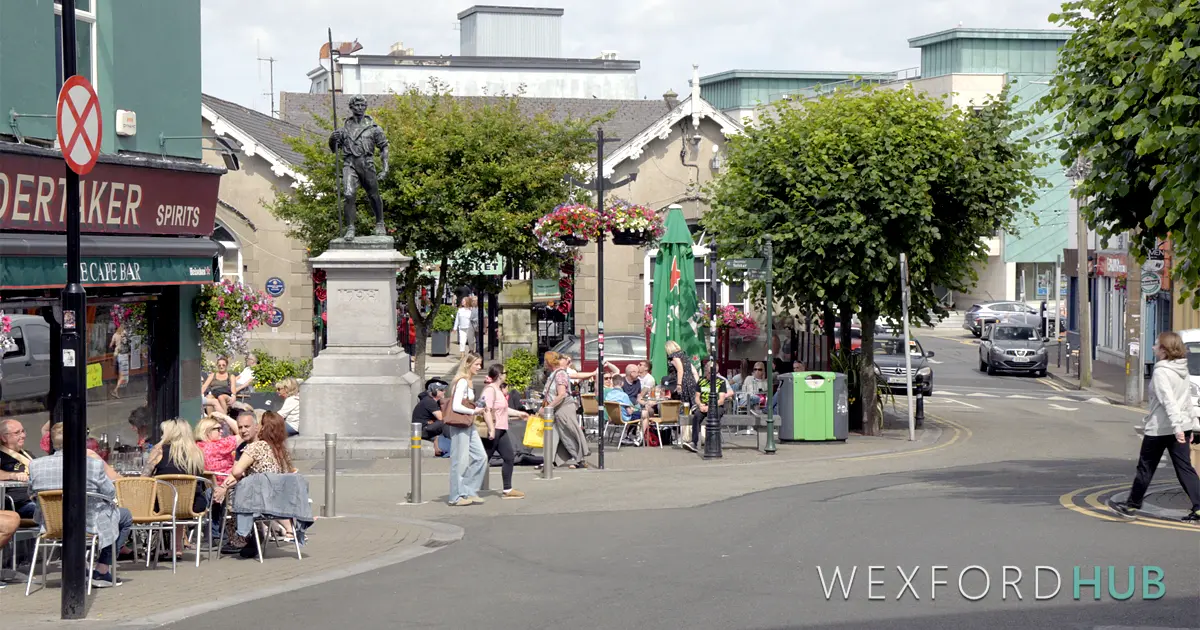
The Bullring is a historic town square in Wexford Town.
Before the area was named the Bullring, it was known as the Common Plain, which may explain the origins of Common Quay Street, an adjoining street that connects to the quay.
The Normans called it “the Shambles” or “the Meat Market,” as it was the designated area for meat merchants, whereas they chose Cornmarket for potatoes and corn.

The Bullring derives its name from the blood sport of bull-baiting, which involved chaining a bull to an iron stake before setting specially bred dogs on it. These “bulldogs” were set upon the bull, one after the other, until it became immobilised. The Guild of Butchers brought the sport to Wexford in 1621, when they organised a biannual bull-baiting event at this location. At the time, the area was known as “the common plain of Wexford.”

The area became the scene of a massacre after Oliver Cromwell’s sacking of the town in 1662. After Cromwellian soldiers breached the walls of the town, they rampaged through its streets, killing people and setting buildings alight. A large number of civilians gathered at the Bullring. Cromwell later recalled the massacre, stating that his soldiers “put all to the sword that came in their way… not many less than 2,000.”
Although historians debate the extent of the atrocities committed during the sacking of Wexford, most agree that Cromwell’s forces killed a large number of civilians, with many drowned in Wexford Harbour as they attempted to flee.
During the 1700s, the area was sometimes referred to as Fountain Square, likely because the Marquis of Ely erected a fountain there.
The square was once home to a courthouse. In his 1764 description of Wexford Town, Amyas Griffiths noted that the courthouse had “an excellent clock, etc., stands.” The courthouse remained in use until the construction of Wexford Courthouse on Wexford Quay in 1806.
During the 1798 Rebellion, the area became home to a pike-making factory used by insurgents to make and repair pikes. The pike was a long spear popular among infantry soldiers, but unlike other spears, soldiers did not intend to throw it.
Bull-baiting declined in popularity at the beginning of the 1800s, as it was seen as a public nuisance. Merchants were also finding it increasingly difficult to procure bulls. During this period, merchants actively sought to rid marketplaces in Ireland and the UK of plebeian sports such as bull-baiting.
The Cruelty to Animals Act of 1835 outlawed the sport.
Timothy O’Connor built the marketplace in 1877, and it has changed very little since.
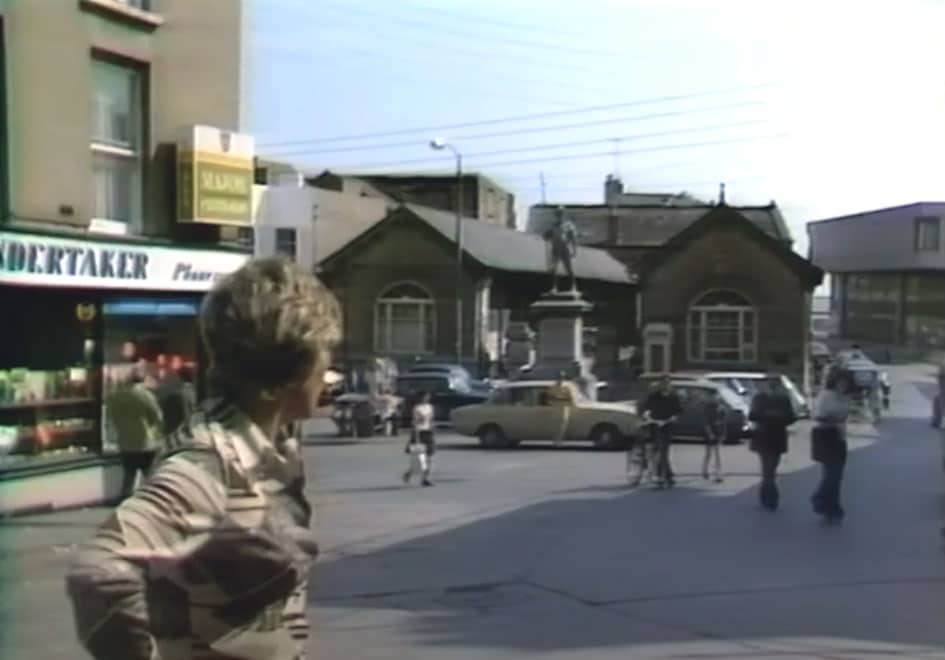
During the centenary commemorations of the 1798 Rebellion, the committee decided to erect a permanent memorial. It accepted the design of a larger-than-life pikeman standing in a heroic pose. Oliver Sheppard, an Irish nationalist and sculptor who later designed the bust of Willie Redmond in Redmond Park, created the design. During the statue’s unveiling in 1905, the town became awash with flags and banners. More than 10,000 people travelled to Wexford Town by train to witness the spectacle.

Video
An old video of The Bullring from 1902, held in the Mitchell and Kenyon Collection, offers a glimpse into life at the time:
In 1910, the murder of a woman called Mary Annes Wildes took place in the apartment above The Cape, visible in the first photograph. The case received significant media attention at the time. Simon Bloom, an artist of Russian descent, served time for the murder and emigrated to America upon his release. At the time of the murder, The Cape was called “The Cape of Good Hope.”
In 1919, the first petrol pump in Wexford Town was installed in the area.
For hundreds of years, the area has been home to a bustling marketplace filled with fishmongers and butchers. In 2012, the market section of the Bullring re-opened after a temporary closure. Traders occupy refurbished log cabins inside the marketplace, selling gifts, food, local crafts, and antiques.

Because of its central location, the Bullring often hosts events and activities ranging from charity drives to protests and festivals such as Wexford Winterland. In the past, it has welcomed historical figures including trade union leader James Larkin, nationalist Eamonn de Valera, and Irish Parliamentary Party leader Charles Stewart Parnell, all of whom used the square to hold rallies and deliver political speeches.
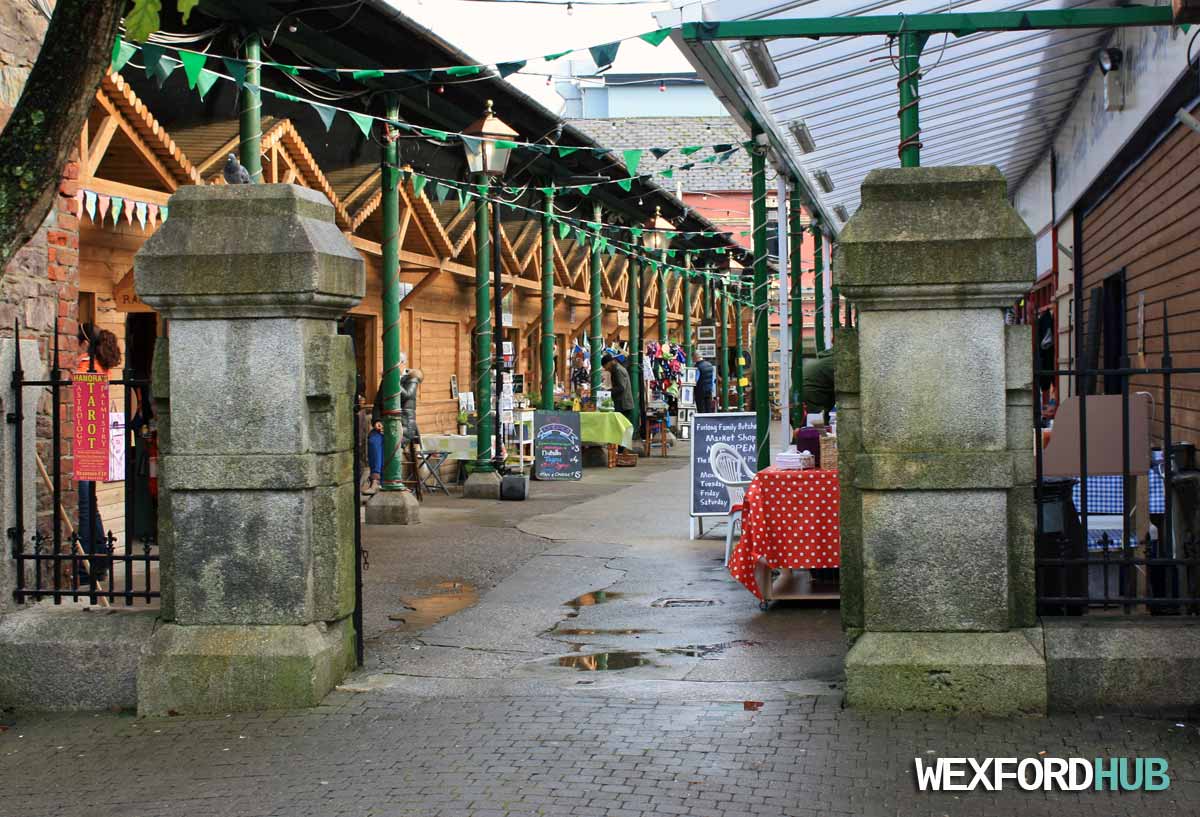
The location also has ties to Oscar Wilde, a famous Irish writer who was renowned for his plays and his novel The Picture of Dorian Gray. His mother Jane Wilde (nee Elgee) is believed to have been born in a rectory that stood in the Bullring (the building no longer exists). The rectory would have been situated in the north west corner, to the left of where the main entrance to the Bullring Market is located (close to a fashion boutique called Diana Donnelly).

Map
A Google Map showing the location of The Bullring, which is situated on Wexford’s North Main Street.