We parsed and categorised over 300,000 County Wexford census records from the 1901, 1911, and 1926 censuses.
The process of correcting and applying OCR to the data revealed several recurring challenges. These findings also highlighted the importance of consulting the original census document rather than relying solely on the plain text shown on census or ancestry websites.
Clerical errors and omissions
Basic human errors were widespread on early census forms. People frequently misapplied “Ditto” marks, recorded the wrong sex, listed a wife as a daughter, misspelled birthplaces, or left entire columns blank.
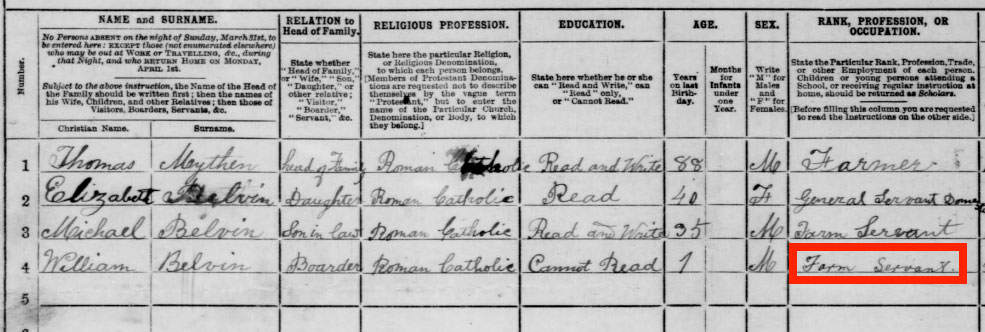
Addresses
House numbers in the 1901 and 1911 censuses rarely correspond to actual postal addresses. Enumerators typically assigned numbers sequentially based on their walking route. Discrepancies in house numbers between the two censuses can therefore create a false impression that a family moved to a different house, when only the enumerator’s route changed.
This geographic confusion extended further. Enumerators were typically officers of the Royal Irish Constabulary (1901 and 1911) or the newly formed An Garda Síochána (1926). They were generally required to serve outside their home counties to reduce local bias. As a result, they had limited knowledge of the areas they were surveying. Unfamiliar with invisible townland borders and colloquialisms, these officers routinely mixed up or misspelled locations.
Streets with “Lower” or “Upper” in their name were also swapped between censuses. A street called “Upper Example Street” in 1911 might become “Example Street Upper” in 1926.
OCR difficulties
The handwritten nature of the data presents a massive hurdle for modern Optical Character Recognition (OCR) software. Forms were filled out in various cursive styles, such as English Copperplate. A “y” can resemble a “g,” a “4” can look like a “7,” a capital “T” may look like an “F,” and a “C” can look like a “B.” If a respondent poorly formed an “r,” the OCR software might read “Mary” as “May.”
Examples include Breen becoming Bruen, Lawlor becoming Lawlar, and Hendrick becoming Handrick.
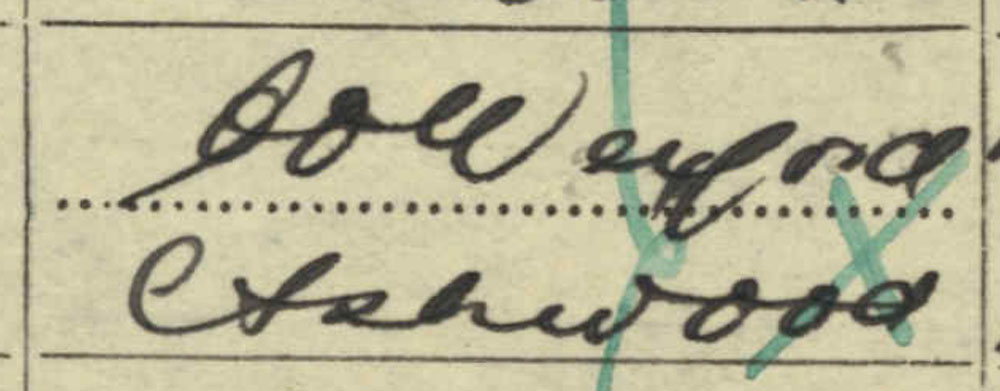
When this data is parsed digitally, thousands of names are effectively lost in search databases because letters are written too close together, or an OCR tool misinterprets a stray ink mark, turning a surname like “Whitty” into “Whity” or “Whitey.”
These mistakes are even more prevalent when a writer’s pen overshot a column, such as the sweeping “R” for Roman Catholic bleeding into the preceding box, or when a writer heavily crossed out text to correct a mistake.
Common OCR mistakes that we saw:
- Double “r” and double “n” being confused, causing places like Annagh to resemble Arragh.
- Looped capital K’s that look like capital R’s (Kennystown looks like Rennystown)
- Dropped letters due to crowded letter spacing and quick “vanishing strokes”
- Capital G’s that look like capital Y’s
While parsing data from the National Archives, we found thousands of birthplaces such as “Westpond,” “Herford,” “Heyford,” “Weefna,” and “Westard.” Most of these corresponded to County Wexford. Despite extensive corrections, there remain 5,920 distinct birthplace entries across 95,598 of the 1926 records.
Tip: If you are unable to locate a relative on the official census website, consider omitting and rewording parts of their name.
Example: If they had the surname Murray, try searching for Munnay, Murey, and Muray.
Ages cannot be trusted
Recorded ages on these forms are highly unreliable, primarily because many respondents did not know how old they were. Exact birthdates were rarely tracked in an era before regular birthday celebrations and widespread literacy. Mandatory civil registration of births only began in Ireland in 1864, so anyone over 37 in the 1901 census had no official birth certificate to reference.
Without documentation, households that were unsure of a relative’s age resorted to guesswork. Those with limited numeracy often rounded ages up or down to the nearest multiple of five or ten, such as 40 or 45. Historians refer to this pattern as “age heaping.”
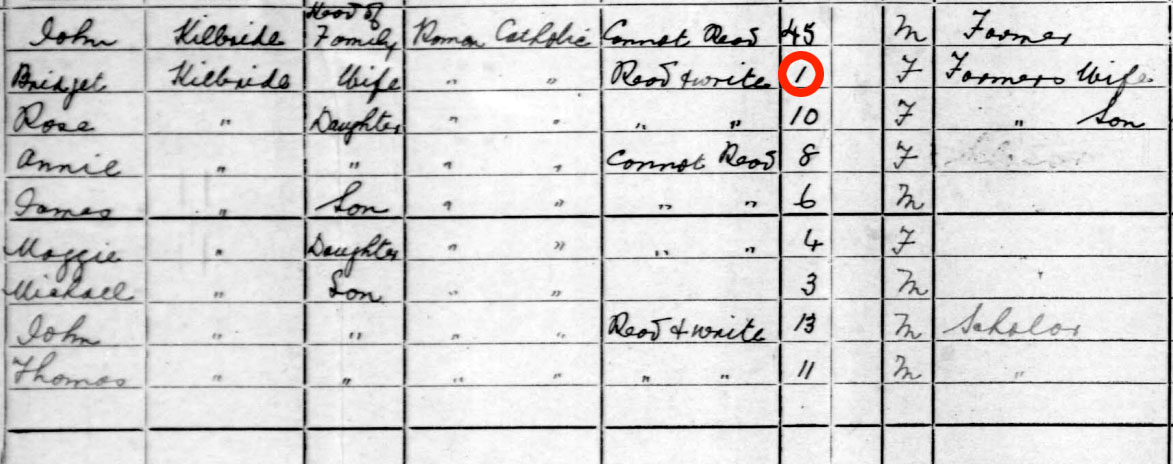
Tip: When researching your family tree, don’t rule someone out just because the age doesn’t match. Check the original census image.
The pension effect
The introduction of the Old Age Pension in 1908 created a further complication in the 1911 census data. Older individuals had a strong incentive to deliberately inflate their ages to qualify for the new payments, making the 1911 age data particularly suspect.
Gaelic revival
Between the early 1900s and the 1920s, the Gaelic Revival sparked a cultural shift. It became increasingly common, and sometimes a political statement, for families to fill out their census forms in Irish, even if they had used English in previous decades.
A man recorded as “John Murphy” in 1901 might appear as “Seán Mac Murchadha” in 1911 or 1926, creating a major obstacle for researchers trying to track relatives across the decades.
This revival also prompted a simpler naming trend: the readoption of traditional prefixes. For much of the 19th century, many Irish families dropped the “O'” and “Mac” from their surnames to sound more Anglicised and assimilate into a British-administered society.
In the 1901 census, a family might appear as “Leary,” “Sullivan,” or “Neill.” By 1911 or 1926, that same family often reclaimed their ancestral prefixes, becoming “O’Leary,” “O’Sullivan,” and “O’Neill.”
For modern researchers, this creates a classic search trap. Typing “O’Leary” into a digital census database for 1901 may return no results for an ancestor who appears under that spelling. To make matters worse for OCR software, the sudden introduction of apostrophes can sometimes be misread as a stray pen mark, a smudge, or a completely different character, further scrambling the index.
The 1926 format and the “Green Pen” problem
The 1926 census presents its own unique OCR challenges for the National Archives due to structural changes. Birthplaces were split across two lines, starting with the county followed by the townland.
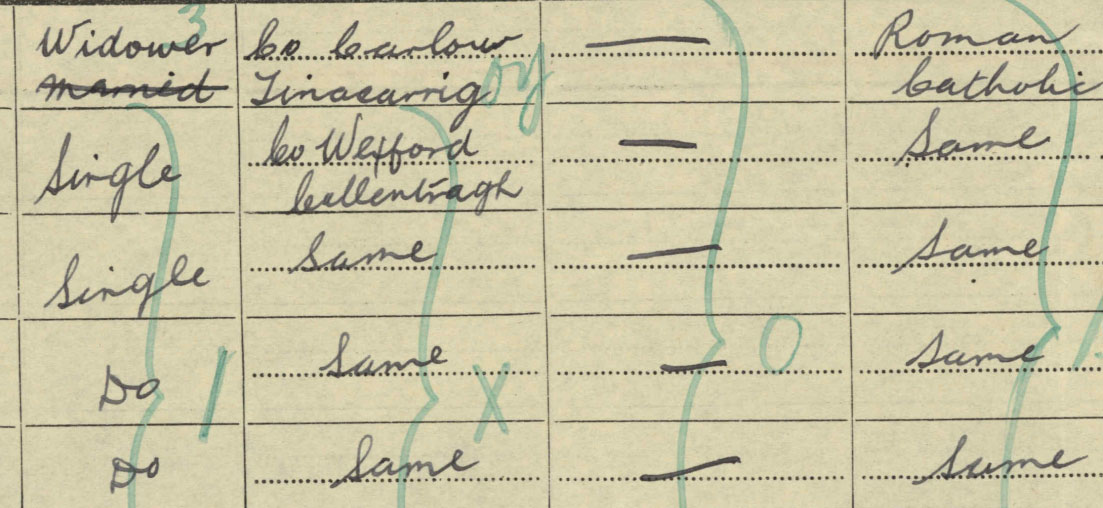
Clerical officers later audited and annotated these forms using green and red pens. Standard OCR tools struggle to differentiate these marks from the original handwriting. The tools might scan a circled letter as a zero or misinterpret a green “0” with a slight curl as a “9.” This occasionally produces bizarre transcriptions, such as young children and grandchildren having their ages recorded in the nineties.
Townlands and vanished streets
Location data is complex. Respondents were inconsistent in how they recorded their addresses, interchangeably using their village, townland, or parish.
Townlands are particularly tricky because similarly spelled locations, such as Drignagh and Dranagh, can be situated on opposite sides of the same county. A single townland might also have multiple accepted English spellings alongside its Irish equivalent, and a village within a townland often shares a deceptively similar name.
Modern tools like Google Maps will often fail when tracing historical addresses, as many streets and towns were renamed following the establishment of the Irish Free State. In County Wexford, the town of Bunclody was formerly known as Newtownbarry.
Older streets in Wexford Town, such as Duke Street, Sinnott’s Lane, Furlong’s Lane, and Paradise Row, were entirely demolished, while Back Street (Mallin Street) and Castle Hill Street (Barry Street) were renamed.
AI helps, but is not a magical fix
AI models with visual capabilities offer a promising solution to these transcription challenges. They are inherently better at cursive pattern recognition than standard OCR and can be specifically instructed to ignore clerical marks.
However, the accuracy of this approach is highly dependent on the specific model used and the researcher’s expertise. Writing the strong, nuanced system prompts required to guide an AI through historical handwriting takes practice and experience.
While many frontier models can accurately transcribe the text, employing these systems at scale can be brittle and costly.
Human reviewers also need to be kept in the loop and provided with tools that allow them to quickly and accurately correct OCR errors.