Duke Street in Wexford Town ran from John Street to Francis Street before it was demolished in the 1960s.
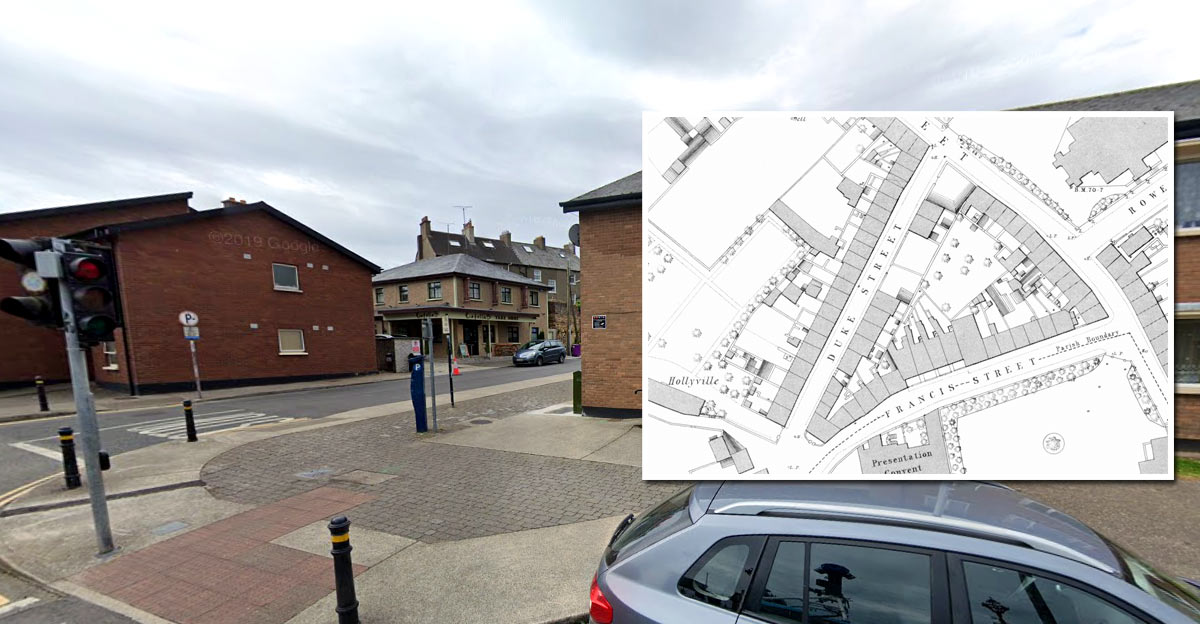
Its northern entrance stood opposite the John Street entrance to Rowe Street Church. The route broadly followed the line of present-day Thomas Clarke Place but lay slightly farther west, crossing the area now occupied by the apartment building opposite the church.
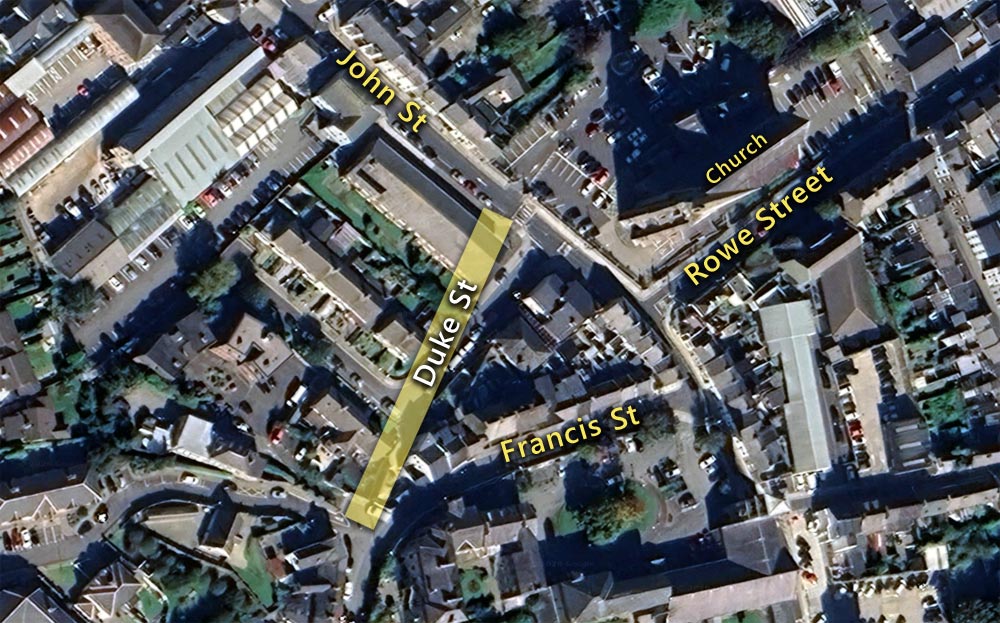
The street was known interchangeably as Duke Street, Duke’s Street, and Duke’s Lane, although the minutes of the local authority generally used the non-possessive form, “Duke Street.” On 1 September 1920, the Borough Council tried to rename the street in honour of Irish republican Thomas Clarke. However, legal constraints prevented the change from becoming official.
1893 report
Dr Thomas Pierse, the medical officer of health, was directed by the Local Government Board for Ireland to inspect the Wexford Urban District for conditions affecting public health. In a report published in the Wexford People on 8 March 1893, he described the unsanitary conditions he found during an inspection of Duke Street.
Several of the houses were overcrowded, with up to 13 people living in a single dwelling. Pigs were kept in “filthy conditions” too close to several houses. There were no outdoor toilets or water-closets. As in many urban areas at the time, residents relied on ashpits, which were small stone enclosures used for the disposal of refuse and human waste.
Dr Pierse’s report noted that the ashpits in Duke Street were “leaky,” uncovered, and not emptied as often as they should have been. The yards were small, uneven, and badly paved. A ruined house at the upper end of the street was being used as a dumping ground and was found to be “full of filth.”
Demolition
The demolition of Duke Street was a protracted process spanning the 1940s to the 1960s.
In December 1940, it was reported that a house occupied by Nathaniel Harris was in a state of collapse and that neither it nor the adjoining house was fit for human habitation. Because they were unable to rehouse the occupants, the Wexford Corporation could not issue a clearance order.
In January 1941, the Minister for Local Government and Public Health indicated that the corporation should proceed with demolition orders for 25 houses in Duke Street.
On 31 May 1950, the council agreed to prepare another clearance order for the area.
Nearly ten years later, on 2 May 1960, the corporation declared Duke Street a Clearance Area under the Housing Miscellaneous Provisions Act 1931. Demolition was actively underway between 1961 and 1963.
A property acquisition plan submitted during this period noted that the street was 75 per cent derelict. By March 1963, the authorities had issued a compulsory purchase order for the Duke Street and surrounding John Street area.
In 1964, the Wexford Corporation began considering draft proposals and layout plans for a new estate. Plans for the development were formally presented to the Minister for Local Government in November 1965.
The new estate was officially named Thomas Clarke Place on 4 December 1967.
Census data
The 1901 census records provide a snapshot of life on Duke Street:
- No. 12: Mary Brien (O’Brien) was a 47-year-old widow who ran a lodging house. She lived with her five children and six boarders. Her two adult sons, Andrew and Peter, were general labourers. Her 16-year-old daughter Johanna was employed as a fowl-plucker, while her youngest child, Mary, aged 13, attended school. Among the boarders were 34-year-old domestic servant Anne Tobin (widow) and her five-year-old son, Walter.
- No. 14: James Dwyer, a 49-year-old bill-poster, lived with his wife, Anne (42), and their five daughters Anne Eliza (17), Mary Kate (15), Teresa (12), Christina (6), and Agnes (4), all of whom were attending school.
1911 census:
- Mary Brien was recorded as living at No. 25, rather than No. 12. However, the discrepancy may have been due to the order in which the census enumerator walked down the street. Despite the passage of ten years, her age was given as 55 instead of 57. Her 32-year-old son, Peter, was the only remaining occupant, indicating that everyone else listed in the 1901 census had moved elsewhere. Peter was still unmarried and had changed occupations, leaving behind his work as a general labourer to become a butcher.
- The Dwyer family were still living at 14 Duke Street in 1911. James Dwyer remained employed as a bill-poster and lived with his wife, Anne, and four of their children. Anne Eliza, Mary Kate, and Teresa were no longer residing in the household. Two younger sons had joined the family: Michael (9) and John (3). Both James and Anne also had notable age discrepancies in the records. James’s age increased from 49 in 1901 to 54 in 1911, while Anne’s rose by only two years, from 42 to 44.
By the time of the 1926 census, the Dwyer family was still living on Duke Street. James, now recorded as being 72 years old, remained at the same address with his wife, Annie, aged 60, and their 18-year-old son, John.
Mary Brien and her son, Peter, were no longer listed as residents.
Map
A map showing its former location: