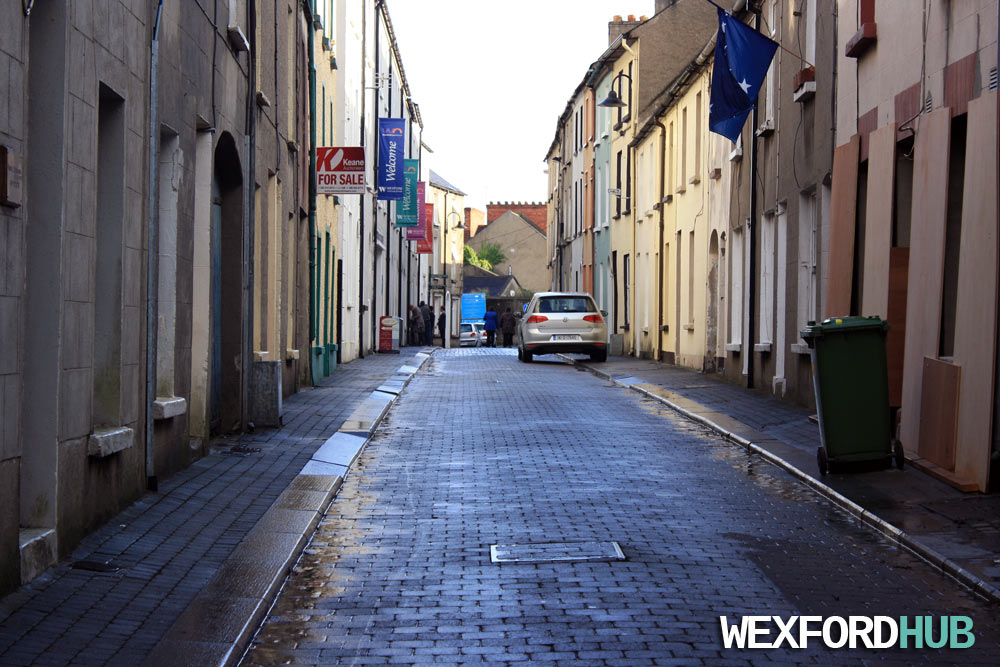
High Street is a historic street in the centre of Wexford Town. It is home to the Wexford Opera House and the ruins of St. Patrick’s Church. This narrow stretch of road runs from Rowe Street to St. Patrick’s Square and Peter Street. Allen Street and Keyser’s Lane connect it to the main shopping area on South Main Street. It is connected to Lower John Street via Mary Street, a short and narrow one-way street that offers a view of the Franciscan Friary.

History
Keyser’s Lane, a narrow Norse lane, ran from High Street to Wexford Quay, cutting through South Main Street. High Street was formerly known as Upper Back Street and appeared on maps dating back to the 1600s. During the early 19th century, the street was referred to as Back Street, a name visible on OSI maps from the period. Ordnance Survey maps from the 1800s show that the present-day car park beside Keyser’s Lane was once filled with houses, many of which were occupied by families of army and navy members.
William Taylor opened the Theatre Royal in January 1832. The building was demolished in 2006 to make way for the Wexford Opera House. According to Nicky Rossiter’s book The Streets of Wexford, the name High Street did not appear until 1883.

During the 1920s, the Borough Council officially renamed the street McSweeney Street. The council had attempted to Irishise the names of several streets around Wexford in the early 1920s, but residents were concerned about the disruption such a change would cause, particularly to postal deliveries. Residents rejected the change in a vote in the early 1930s. Despite the vote, the McSweeney Street nameplates remained in place for decades, and the High Street name was not restored to the street signs until much later.
The Wexford Opera House was officially renamed the National Opera House during the Wexford Opera Festival in early September 2014. It is 3-4 times larger than the Theatre Royal building it replaced.


Map
A Google Map showing the location of High Street:
Related: Photographs of Wexford Town.