Cornmarket is a historic marketplace in the heart of Wexford Town.
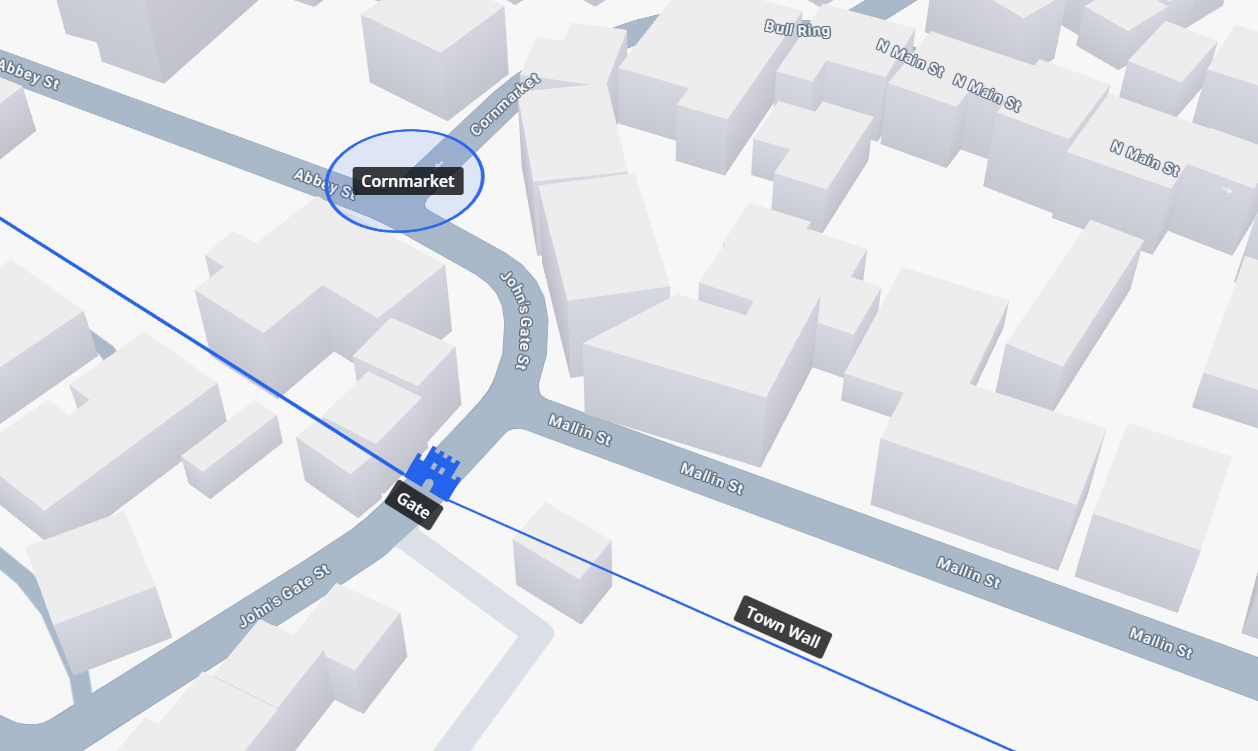
Its roundabout serves as a junction between Abbey Street, North Main Street, and John’s Gate Street.
Local historians believe the site may originally have been the location of an Irish settlement that predated the arrival of the Vikings around 820 AD.
The Normans formally established the area as a market in the late 12th century.
It later became the town’s principal trading centre for corn, which is how the street got its current name.

The market continued to prosper under Norman rule. During the medieval period, Wexford was enclosed by a defensive wall with seven gates. Authorities decreed that all corn had to be traded at Cornmarket. They designated John’s Gate, near the present-day exit of the Rowe Street Church car park, as the official entrance for farmers bringing produce into the town.
Today, Cornmarket remains a busy commercial centre, hosting businesses such as Permanent TSB, Wright Insurance Brokers, PwC Ireland, Kirwan & Kirwan Solicitors, Beans & Bites, Paula’s Barbers, and Thomas Moore Tavern.
It is also the home of Wexford Arts Centre.

Wexford Arts Centre
The Wexford Arts Centre occupies a historic building on the western side that was originally known as The Market House or The Assembly Rooms.

Construction began in 1772 and was completed in 1776. The building featured open arches on the front, which were later converted into windows to facilitate trading. There was also a ballroom and a supper room on the top floor.
It served as the town hall for the Wexford Corporation until 1951, when the council relocated to the municipal buildings in Wygram.
In 1974, the building became the Wexford Arts Centre.
Thomas Moore
The building that houses Thomas Moore Tavern was built circa 1750 to serve as a three-storey house. It was the birthplace of Anastasia Codd, who was the mother of Irish poet and songwriter Thomas Moore.
During the mid-2000s, the building was renovated and connected with the commercial building beside Whites Hotel.

The Gut
The section beside Kelly’s of Cornmarket was known as The Gut before it was widened to accommodate traffic.
The Gut connected The Bullring and North Main Street with the Cornmarket.
This is a common term used to describe narrow passages, sometimes referred to as “squeeze-gut” alleys.

The building now housing Kelly’s of Cornmarket comprised several different shops in the past. It also contained an independent church called Bethesda with Reverend Thomas Dillon as its pastor. A theatre operated here from around 1830 until 1832.
Map
A map showing its location: