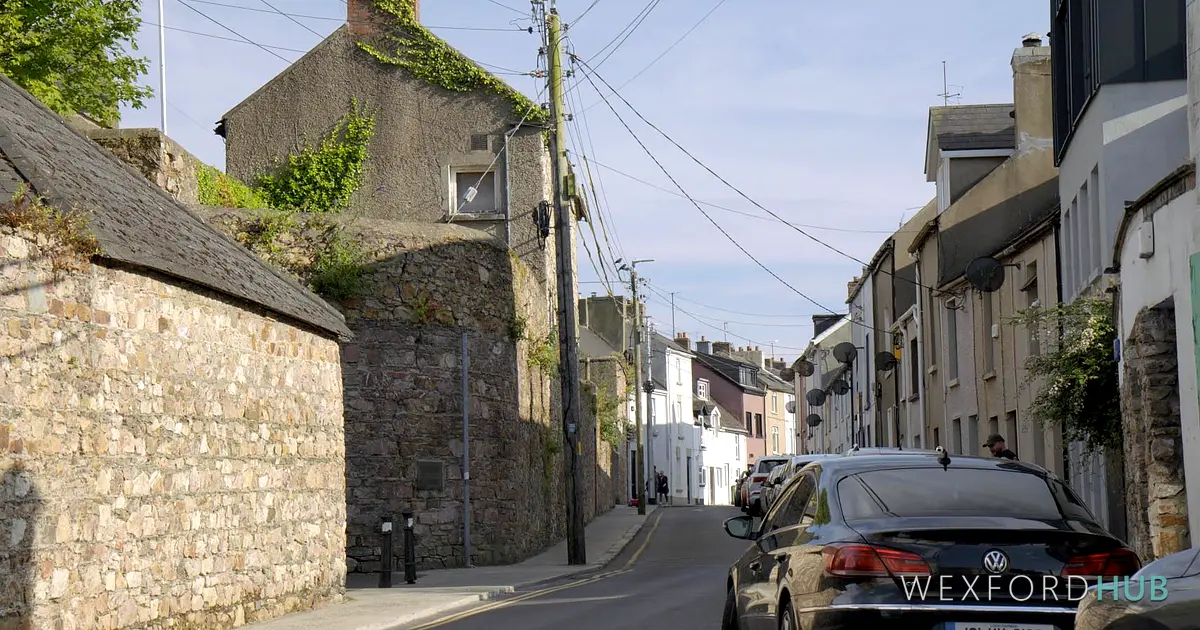
Barrack Street lies in the southern half of Wexford Town. It runs from the intersection of South Main Street and King Street to Parnell Street, opposite Lambert Place.
The street takes its name from the 18th-century military barracks located there.

A pre-Norman defensive ditch once existed on the street. Two Norse-Irish churches, the Church of the Holy Trinity and St Doologue’s, also stood in the area. The site later became home to Wexford Castle, a 12th-century Norman castle. During Cromwell’s siege of Wexford in 1649, the ruins of the two churches were used to repair structural damage. No physical trace of either church remains.
The barracks opened in 1725. Before its construction, the military demolished Wexford Castle to make way for the base.
Some of the houses on Barrack Street date back to the late 1700s and early 1800s.
Evidence suggests the barracks also served as a gaol during the 1800s. Castle Gate, one of six gates providing public access to the walled town of Wexford, stood on the street.
During the 1920s, local authorities renamed the street Macken Street, possibly after Peadar Macken, who died during the 1916 Rising. Voters rejected the change in a 1932 plebiscite.
During the mid-1990s, the defensive ditch was discovered on the street. Historians believe it was part of the original defensive structure that existed before the Normans arrived in the 12th century.
A small pedestrian lane called Slaughterhouse Lane, also known as Salthouse Lane, connects the street to Trinity Street and the car park at the Talbot Hotel.
1901 Census
The 1901 Census shows that families such as Howlin, Whitty, Cullen, Murphy, Kehoe, and Dunbar lived on Barrack Street. A few examples of the households recorded:
- 5 Barrack Street: Three members of the Whitty family lived here. John Whitty (26) lived with his wife Mary Ellen (28) and their daughter, Elizabeth Whitty (4 months). Whitty was a fitter in a local foundry, and she was listed as a housekeeper.
- 7 Barrack Street: Six members of the Dunbar family lived here. Although the head of the household, Susan Dunbar (36), was listed as married, her husband is not recorded on the census form, possibly because he was working elsewhere at the time. They had five children: Jack (11), Sarah (9), Kamok (6), James (4), and Robert (2). Kamok is an unusual name that may have been incorrectly transcribed. The name could have been Hannah.
- 12 Barrack Street: Mary Larkin (59) lived with her 23-year-old son William Larkin, who was a postman. Larkin was listed as a widow.
Map
A map showing its location: