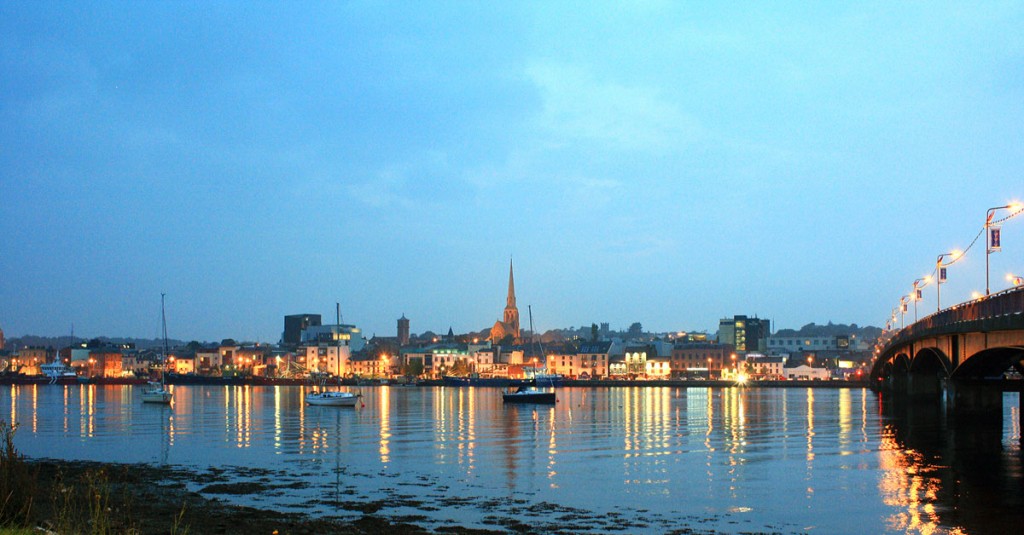
Wexford Town, the county town of County Wexford in Ireland, is a historic Viking settlement at the mouth of the River Slaney. Viking raiders founded the town at the end of the 8th century, in 800 AD, constructing a small settlement overlooking Wexford Harbour.
The name Wexford originates from the Old Norse word Veisafjǫrðr, also rendered as Waesfiord and pronounced Veisford. It means “inlet of mud flats” in Old Norse, a northern Germanic language that Scandinavian peoples spoke until the end of the 14th century. Following Wexford Town’s establishment in 800 AD, the native Irish and the Norse newcomers began to integrate, trading and intermarrying until the population in the region became a unique mixture of Norse-Irish.
Over the centuries, foreign invaders, violent sieges, an insurrection, the establishment of Ireland’s first republic, and the gradual decline of its once-busy harbour have reshaped this port town.
The Vikings
The Vikings originated from countries including Sweden, Norway, and Finland. Their advanced seafaring skills, coupled with their raiding tactics, made them a feared enemy. This fear of Viking raiders forced many people in the coastal areas of Ireland to move further inland. By the end of the 8th century, the Vikings had begun their period of expansion, in which they pillaged Christian monasteries and established bases in coastal areas including Wexford, Dublin, and Waterford.
Before the Vikings arrived, the Greek geographer Claudius Ptolemy is thought to have identified the area around Wexford Town as Menapia in his treatise Geographia, published around 140–150 AD. Ptolemy likely never visited Ireland himself. His map was instead compiled from reports provided by Roman traders, sailors, and explorers. He placed Menapia on Ireland’s east coast, north of the Sacred Cape, generally identified as Carnsore Point. Because of this placement, many historians and cartographers associate Menapia with modern-day Wexford Town. The identification remains debated, however. Since Ptolemy’s coordinates and coastline orientations were somewhat distorted, some authorities argue that Menapia was located further north, closer to Wicklow Town. At the time, Celtic tribes including the Brigantes and the Coriondi inhabited what is now County Wexford.
The first recorded raid in Wexford Town occurred in 819 AD, when Vikings plundered the Christian monastery on Begerin Island in the North Slob area of Wexford Harbour. Although the Vikings were persistent in their attacks, the native Irish met them with fierce resistance, and it took decades before the Vikings were able to establish themselves in the country. After years of skirmishes and nighttime raids in which the Norse population of Wexford Town suffered several defeats, a second wave of Viking raiders began to arrive. While these raids persisted, it was through trade that the Norse made their biggest impact on Ireland.

During this era of integration, the Norse, who had once devoted themselves to a form of Germanic paganism, began to accept the tenets of Christianity. This acceptance of Christianity played a significant role in the layout of medieval Wexford Town, leading the Norse to build several small parishes in the area. Unlike the Anglo-Normans, who favoured larger parishes, the Norse seem to have preferred a complex system of tight-knit parishes, most of which were located within a few hundred metres of one another. This explains why St. Peter’s Church, St. Mary’s Church, and St. Patrick’s Church in Wexford Town were all built so close together.

The Viking past of Wexford Town is still apparent today, as the town centre consists of narrow streets with small lanes that slope down towards the quay. One example is Keyser’s Lane, a narrow lane that runs from High Street to the car park on Crescent Quay.
Because of its proximity to busy shipping routes in the Irish Sea, Wexford Town was considered a strategic location throughout much of the Middle Ages and was frequently targeted by invading forces.
The Normans
In May 1169, a force of approximately 1100 Norman soldiers marched on Wexford Town. These men were led by Robert Fitz Stephen, Maurice de Prendergast, and the recently deposed King of Leinster, Diarmait Mac Murchada. Three years previously, Mac Murchada had fled to Wales after being forced to vacate his throne by the High King of Ireland.
While in Britain, he asked King Henry II of England for permission to enlist mercenaries from within his kingdom. After Henry II consented, the deposed king immediately began recruiting Norman barons from the Pembroke area of South Wales. In return for their help, Mac Murchada promised them money and land ownership. He promised the Norse town of Wexford to Robert Fitz Stephen and Maurice Fitz Gerald.
The Norse-Irish inhabitants of Wexford Town mounted a strong defence on the first day of the siege, inflicting casualties on the Norman invaders and repelling them. However, the next day, they decided to open negotiations with Mac Murchada, as their confidence in defending the town had started to falter. The town’s stone wall did not exist at the time and the Norman troops were of high calibre, making the town’s fall inevitable. At the time, refusing to surrender carried severe consequences.
After the town had surrendered, Mac Murchada divided the land among Fitz Stephen and Fitz Gerald and incorporated some of the Norse men of Wexford Town into his army before marching onward to reclaim his crown. To fortify the region, Robert Fitz Stephen built a wooden ringwork castle on top of a large rock at Ferrycarrig, overlooking the River Slaney. The defensive ditch is still visible inside the Irish National Heritage Park.
The arrival of the Normans was another important part of Wexford Town’s lengthy history, as they expanded the town further north, leaving historical sites including Selskar Abbey and Westgate Tower. They also constructed Wexford’s town wall, a stone wall that looped around the town in the shape of the letter C.

The surnames found in County Wexford today reflect the region’s successive waves of settlement. Old Irish names such as Byrne, Buggy, Kavanagh, Healy, Heffernan, and Murphy sit alongside surnames believed to have Viking origins, including Sweetman and Doyle. Anglo-Norman family names such as Roche, Devereux, Furlong, Whitty, Hore, Laffan, Hayden, Redmond, and Neville are also common. These name patterns chart the demographic changes in the region.
The Norman invasion of Wexford Town also led to the creation of a language called Yola, which evolved from Middle English. Throughout the Middle Ages, this unique dialect of English developed and continued to flourish in the southern Wexford baronies of Forth and Bargy. Wexford Town remained strategically contested in the centuries after the Norman invasion.
Cromwell
On a rainy day in October 1649, another foreign army arrived at the outskirts of Wexford Town. This army, led by the Lord Protector of the Commonwealth of England, Scotland, and Ireland, Oliver Cromwell, set up camp north of the town, close to where Carcur and Spawell Road are today.
Two months earlier, Cromwell and his New Model Army had landed in Ireland with the intention of crushing the Irish Catholic Confederation: an alliance of Irish Catholic nobles, clergy members, and military leaders that had been in control of Ireland for several years. The English Parliament considered this alliance a military threat to the newly established parliament. Throughout the years that preceded Cromwell’s arrival, Wexford Town’s port had been used as a base by Confederate vessels, many of which had been attacking and stealing from ships belonging to the English Parliament.
A few days after his arrival at Wexford Town, Cromwell encircled the town to the west before setting up a new camp in ‘The Rocks,’ lying to the south of the town. While negotiations between Cromwell and the garrison of the town were still ongoing, his New Model Army managed to capture Wexford Castle. The capture of the castle panicked the town’s garrison, causing them to flee. The sight of Cromwell’s men turning the guns of Wexford Castle on the town wall shocked the garrison, especially given that stories of Cromwell massacring the people of Drogheda were fresh in their minds. From that point onward, Cromwell’s soldiers decided to seize the opportunity to breach the walls of Wexford Town. Once the walls were breached, Cromwell’s New Model Army rampaged through the streets of the town, killing the town’s defenders and massacring its civilians.
Historians dispute whether a massacre took place at The Bullring, where townspeople had gathered. In his letters, Cromwell wrote that his army had entered a marketplace and that they had put ‘all to the sword’ that ‘came in their way.’ He also recalled how boats of people trying to escape the town had capsized in Wexford Harbour, causing the deaths of 300 people. Over a decade later, during the 1660s, Wexford Town requested compensation from England, arguing that over 1,500 townspeople had been killed during the sacking.
Regardless of whether any such massacre took place, the town lay in ruins. It was so badly damaged that Cromwell and his men regretted not being able to use it as winter quarters. In the aftermath of the sacking, many of the remaining Catholics in Wexford Town fled, hiding in the countryside until the following spring. After returning, many of them learned that their lands and houses had been confiscated and that they were now tenants in their own homes.
In the period that followed, Cromwell’s forces seized the land around Wexford Town and handed it over to a Protestant minority, marking yet another change in the history of the town. For centuries to come, the English elite repressed Catholicism and controlled Wexford Town. As a result, many of the town’s old Catholic churches fell into ruin, their stonework plundered for building supplies. St. Peter’s Church is one such example.
1798 Rebellion
We are the boys of Wexford, who fought with heart and hand.
As the 18th century was coming to a close, the anger and frustration of the Catholic community were growing. For decades, they had lived under a system that favoured Protestants: an unfair system that saw them suffer economically. In the years leading up to the Rebellion of 1798, both America and France had erupted into revolution, fuelled by the ideals of equality, justice, and democracy. Events in other countries eventually led to the creation of a group of nationalists called the United Irishmen, comprising both Catholics and Protestants, all of whom believed in the establishment of a secular democracy.
In County Wexford, the sense of anger at the establishment continued to build, largely due to the events that took place at Wygram in Wexford Town in 1793. There, several Irish rebels from Bunclody were halted by members of the 56th Regiment as they attempted to free two of their neighbours from Wexford Gaol. During a skirmish between the two sides, members of the 56th Regiment shot and killed eleven Irish rebels, and nearly a hundred more died of their wounds while attempting to flee the town. The Regiment captured several survivors and sentenced them to death by hanging. This event is sometimes referred to as The First Rebellion, because it helped to fuel a sense of enmity that would eventually culminate in the insurrection of 1798.
Wexford Town was not immediately involved in the 1798 Rebellion, as the rising had started in the north of the county. At the end of May 1798, a force of about 10,000 rebel soldiers arrived at Three Rocks on Forth Mountain, on the outskirts of Wexford Town. At this point, the United Irishmen’s position appeared strong, having already seized Enniscorthy. They did not yet know that the uprising had been crushed in other parts of the country.
The arrival of this large force of Irish rebels panicked the loyalist inhabitants of Wexford Town, as many worried about what would happen to them if the town were to fall. The town’s garrison was small compared to the rebel force and was unable to adequately strengthen the town’s defences in time. Rebel forces had also started to gather at Ferrybank, on the opposite side of Wexford Quay.

British reinforcements from Duncormick retreated from the area, and the town garrison suffered a heavy loss at the hands of the rebels. The remaining soldiers inside the town discarded their weapons and abandoned their posts, allowing the United Irishmen to enter the town unopposed.
Ireland’s first republic had been proclaimed.
During this phase of the 1798 Rebellion, the United Irishmen established a republican regime in Wexford Town under civilian leadership. After a period of law and order within the town, an extremist faction of Pikemen led by Thomas Dixon gained control of the streets of Wexford Town. Before that, the moderate leadership within the United Irishmen had protected loyalist prisoners from the random executions occurring elsewhere, seeing them as a potential bargaining chip. This changed, however, as the more moderate leaders of the United Irishmen were drawn to events occurring elsewhere in the county. This eroded the authority of the civilian leadership, allowing extremist factions within the town to take control.
When the leaders of the United Irishmen returned to Wexford Town, they learned that an atrocity had occurred in their absence. Dixon had put approximately 100 loyalists on ‘trial’ and sentenced them to death before his men executed them on Wexford Bridge.
British forces executed many of the leaders of the rebellion on Wexford Bridge after regaining control of the town.
Further reading: Articles about Wexford’s history.