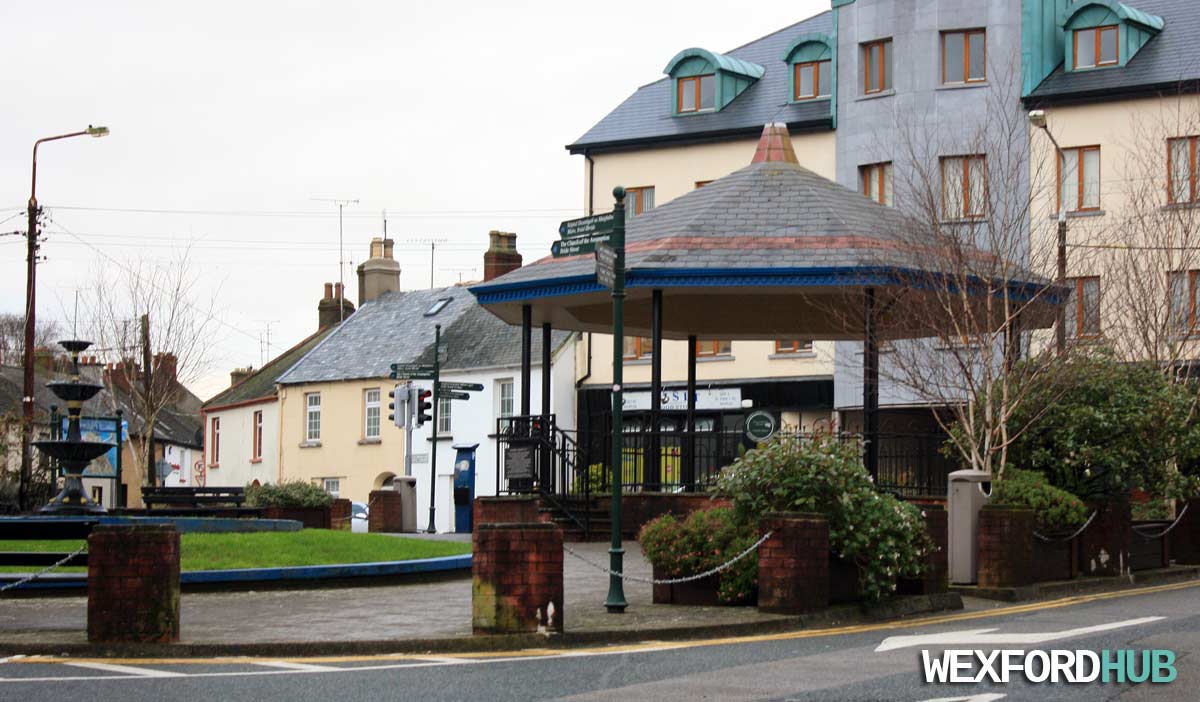
St. Peter’s Church was one of the Norse-named parishes in Wexford.
It stood where Peter’s Square is today, a short distance from St. Patrick’s Church in High Street and St. Mary’s Church in Mary’s Lane.
In Viking towns, it was common to have many parishes within a small area. Norse towns frequently named their parishes after saints such as St. Mary, St. Peter, St. Patrick, and St. Michael, which is why these names also appear in Waterford and Dublin.

A map from 1840 shows the ruins of St. Peter’s Church in Peter’s Square. The map indicates that the road around the square was once called The Old Pound, a name later given to a local newsagent’s shop, The Olde Pound, which closed in the mid-to-late 2000s.
A graveyard lay to the south of the church, in the area between St. Peter’s Square and the former Wexford garda station.
The church was located outside the town wall, close to Peter’s Gate, which stood at the top of Peter Street (then known as Gibson’s Lane).
Peter’s Gate was removed by the borough council in the late 1700s to accommodate increasing traffic.
In his book Wexford: A town and its landscape, Billy Colfer describes how the Papal Nuncio to Ireland, Giovanni Battista Rinuccini, visited Wexford during the Easter period of 1647. He was greeted by a military guard of honour, celebratory cannon fire, and music. After an official reception by Wexford Corporation, Rinuccini visited St. Peter’s Church, where a welcoming mass honoured him. He remained in the town for several days afterwards.
Only two years after Rinuccini’s visit, Oliver Cromwell, the Lord Protector of the Commonwealth of England, Scotland, and Ireland, arrived at the walls of Wexford Town. A few days into the siege, Cromwell’s New Model Army gained access to the town and caused significant damage.
In the period following Cromwell’s conquest of Ireland, anti-Catholic legislation took hold, leaving the old Norse churches of Wexford Town in ruins. Cromwell’s forces also sacked St. Mary Magdalene’s Church in Maudlintown in the years after his arrival.
Because Cromwell’s cannon fire in 1649 had damaged the walls of Wexford Castle, St. Peter’s Church was later demolished to reuse its stone for repairs.
In the late 1930s, Wexford garda station was built on Roche’s Road. Before that, the area in front of Roche’s Terrace was known as The Deddery, sometimes spelled as The Deaddery. The name likely derived from the ancient graveyard of St. Peter’s Church.
A black and white photograph from the early 1930s shows an uneven, hilly patch of land. During the construction of the garda station, several sets of human remains were uncovered and later reinterred in St. Ibar’s Cemetery in Crosstown.
Map
A map showing its location: