The ruins of St. Patrick’s Church stand at the end of High Street, close to the centre of Wexford Town. Its surrounding graveyard, which is bounded by the town wall, holds the bodies of victims of Cromwell’s sacking of the town in October 1649. The site is also the resting place for many people killed during the 1798 Rebellion.
The church dates back to medieval times and is one of the earliest surviving and best-preserved Christian ecclesiastical sites in the town. The parish it belonged to was one of the five parishes that existed inside the walls of the Norse-Irish town of Wexford. At the time, it was common for Norse towns to have a complex parish system, with multiple parishes within a relatively small area. Although the year of its establishment is unknown, it predates the Norman invasion of Ireland in 1169.
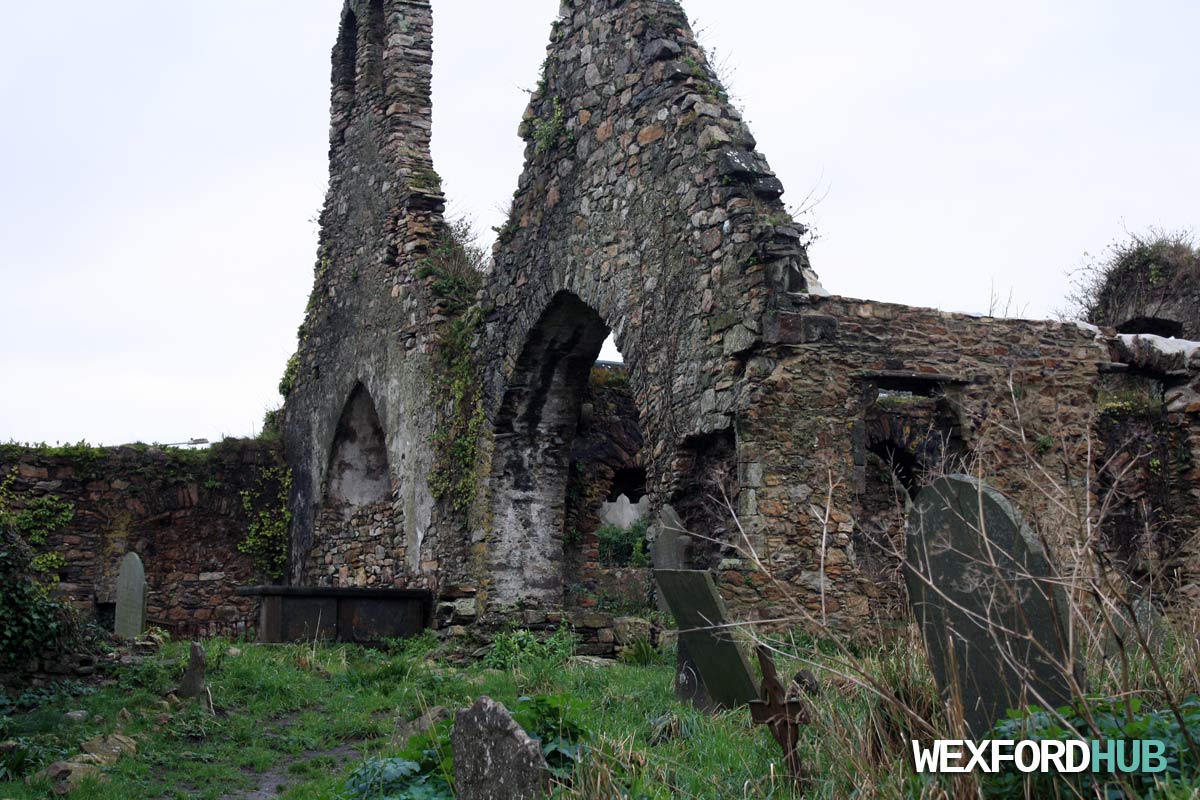
St. Patrick’s Church is the resting place for the headless body of United Irishman John Henry Colclough, whom the British executed on 28 June 1798.
During an attempt to flee to France, he and his wife were betrayed by a local farmer on the Saltee Islands. Following his arrest, he was returned to Wexford Town and hanged on Wexford Bridge. Afterwards, his head was displayed on a pike.
Later that night, a group of nationalists recovered Colclough’s body and brought it to the grounds of St. Patrick’s Church. His head was never found.
A clay rampart in the vicinity of the church is a defensive structure that was built to defend against Oliver Cromwell’s cannons in 1649.
Map
The gates typically open between 11 a.m. and 3 p.m. The entrance is at the end of High Street, near the top of Allen Street and Patrick’s Lane. There is a car park on High Street, but it can be very busy depending on the day of the week.