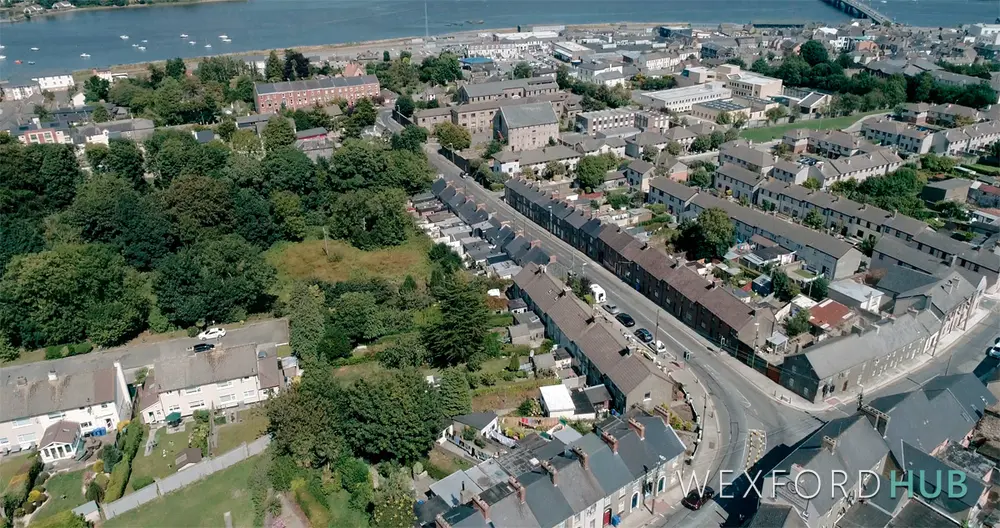
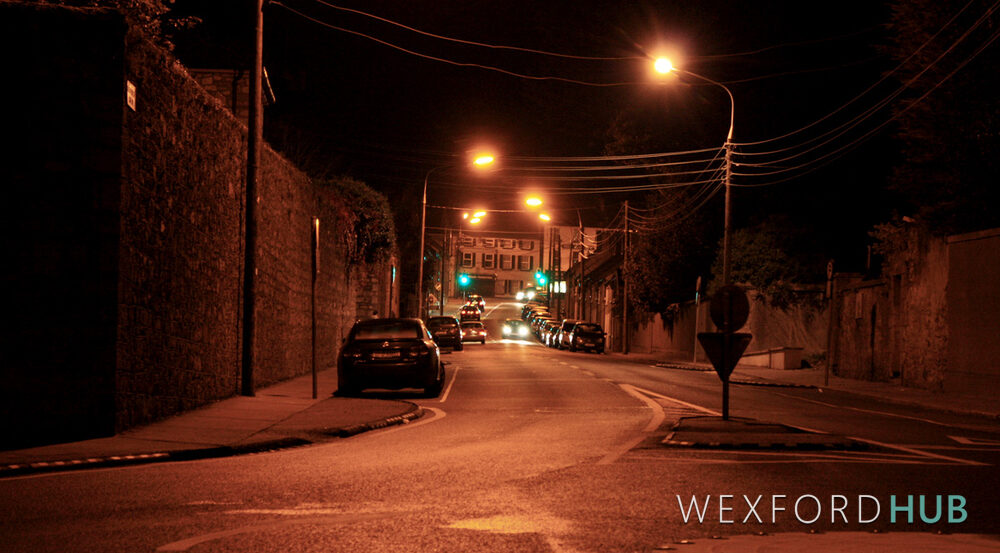
Hill Street runs through the northern part of Wexford Town, connecting Wygram and Newtown Road to the Spawell Road roundabout. It forms part of the R769 regional road and was formerly the pre-bypass route of the N25.
Cabbage Row
The street was formerly known as Cabbage Row, a nickname that came from residents using their fertile gardens to grow cabbages. A Wexford People article from 6 November 1858 noted that “a lamp was much wanted over John’s-gate, near John Street, and midway up Cabbage Row, where a number of bad characters congregated.”
The current name likely derives from the sloping characteristics of the street.

Construction
Hill Street became a focus for municipal working-class housing from the late 19th century. In 1895, Wexford Corporation acquired a plot of land from Thomas Bent for £40. By the 1910s, thirteen houses had been erected at a capital outlay of £2,919.
In 1912, the corporation expanded by acquiring a field at Windmills Hill from the Community of St. John of God, planning 18 new working-class houses. The land adjoined the old manure depot.
During the 1930s, as part of slum clearance that condemned areas such as Wethereld’s Court, Water Lane, and Stonebridge Lane, the council acquired more of Bent’s land to build an additional 22 houses, comprising fourteen four-room and eight three-room dwellings.
To reduce costs, the houses were built using an experimental material called Nofrango instead of traditional concrete blocks.
The experiment proved a costly failure.
In 1936, the borough surveyor reported that the roofs were leaking severely due to movement and abnormal shrinkage in the unseasoned timber sheeting. The Nofrango company refused to guarantee the roofs, and the corporation was forced to re-roof the houses with asbestos slates at an additional cost of approximately £450.
Old Croke Avenue was built on Hill Street around 1932. On 14 January 1933, the mayor gave formal notice of his intention to name the “new Avenue at Hill Street” as Croke Avenue.
In 1940, a resident’s house became so heavily infested with bugs that the walls were ruined by eradication attempts. The council ordered it to be limewashed for three months before it could be properly repainted. In earlier years, properties had also lacked proper sanitary accommodation, requiring the council to serve notices for the installation of water closets (toilets).
Renaming attempt
In 1920, as part of an initiative to rename nineteen streets after Irish patriots, the Borough Council attempted to rename Hill Street to Seán MacDermott Street. Because the changes were made “irregularly,” the council had to hold a formal plebiscite in 1932, under the Public Health Acts Amendment Act of 1907.
The vote failed to secure the required two-thirds majority of ratepayers, and the name remained Hill Street.
Two smaller rows of houses at the top of the street were later named St. Ita’s Terrace (1932) and Seán MacDermott Terrace (1953). Councillors had initially proposed naming the 1932 houses De Valera Terrace.
In 1953, the mayor directed that the row of houses near Wygram be named McDermott Street. The dwellings were numbered 37 to 51, continuing sequentially from the existing houses on Hill Street.
Businesses
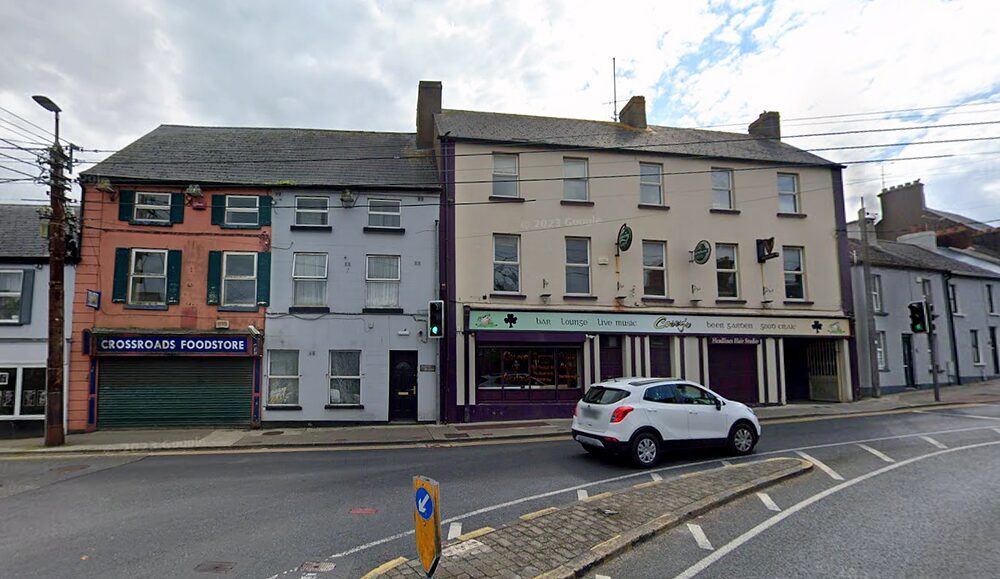
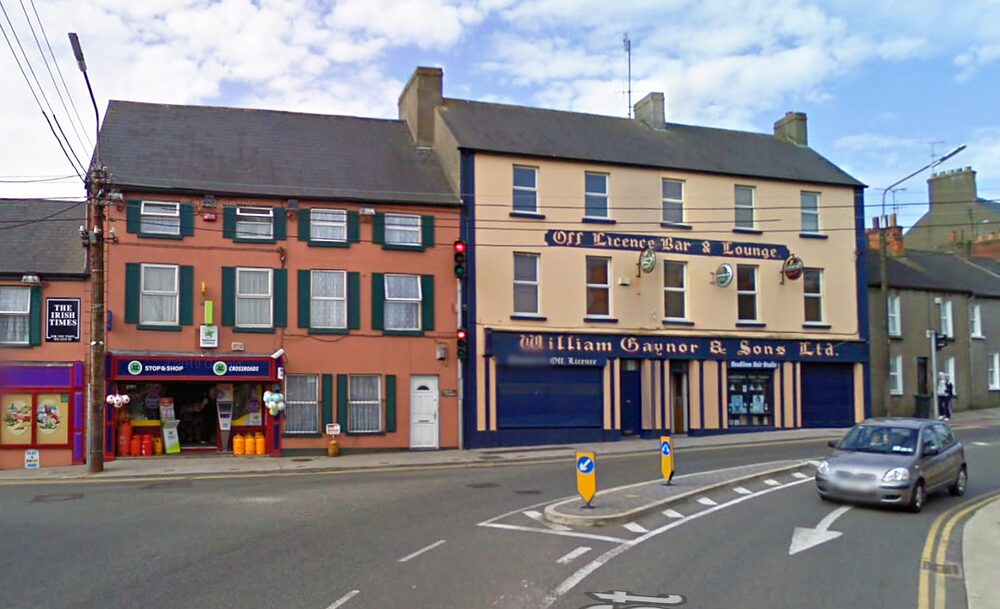
Paddy Murphy and his wife Breda opened Crossroads Foodstore at the top of Hill Street in 1969. Their son Erdie later took over the business.
After 44 years in operation, the shop closed in August 2013. In the years leading up to its closure, trade had declined. Murphy later said that the installation of traffic lights at the junction had made it difficult for motorists to stop for fuel or call into the store. He believed the traffic management system had directly contributed to the business’s downturn. The closure was also linked to Murphy’s cancer diagnosis, which resulted in the loss of a leg.
He passed away in October 2014, aged 49.
William Gaynor’s pub was originally established on Main Street in the 1920s. Following William’s death in 1968, the business passed to his son Gerard Gaynor and relocated to Wygram at the top of Hill Street. The pub occupied the building previously operated by the O’Brien family.
In later years, the pub was run by Gerard’s son Johnny Gaynor and his wife Annette. The Gaynors retired in 2022 and the pub was sold at auction for €600,000 to a group of Florida-based investors. The new owners subsequently renovated and rebranded the premises as Casey’s of Wexford. One room was retained as a tribute to Gaynor’s, while another was redesigned with a “New Orleans-inspired theme.”
Historic sites
The red terraced houses of Glena Terrace stand beside the roundabout on Spawell Road. The entrance to the former county hall, which once stood on the grounds of Wexford Gaol, is also located on Hill Street.
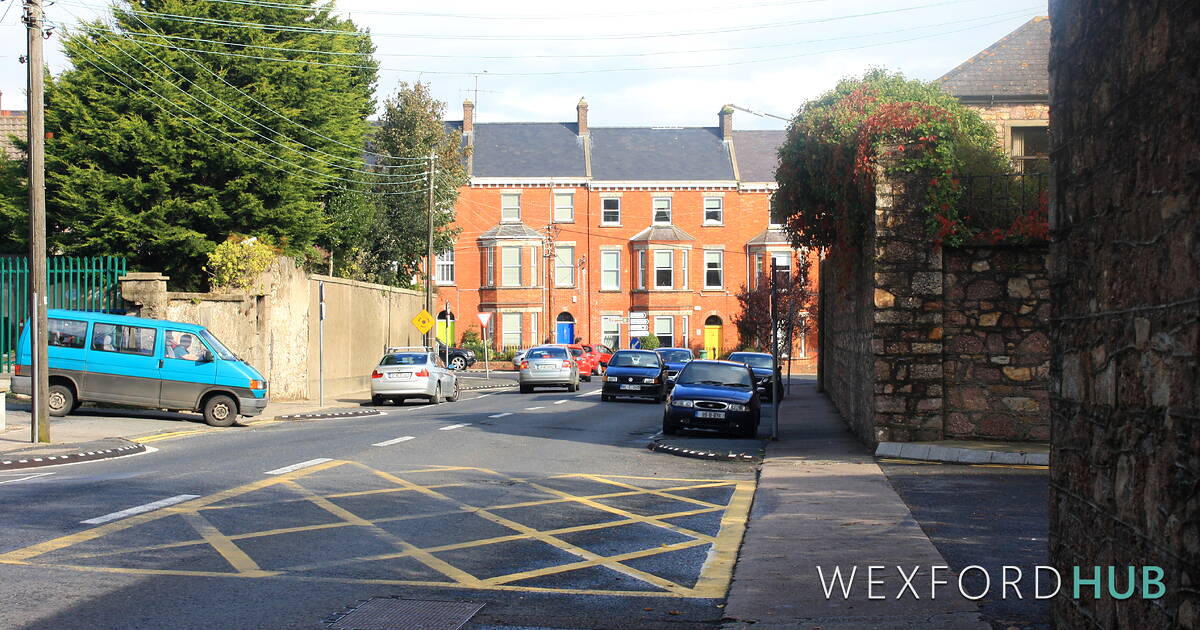
The Wexford County Infirmary was established on Hill Street in 1767. During the United Irish Insurrection in May and June of 1798, it was taken over and used as a hospital for wounded insurgents. After Crown forces recaptured Wexford on 21 June 1798, troops under General Gerard Lake set the hospital on fire, and 57 wounded insurgents being treated inside lost their lives.
A gateway from 1840 stood at the entrance to the infirmary grounds, with a rusticated rendered block-and-start surround framing a timber-boarded door. A plaque commemorating the massacre was also located on a nearby wall. The original stone wall and gateway were later removed to facilitate the construction of a car park and offices for the County Wexford Chamber. The plaque was relocated inside the car park near the entrance.

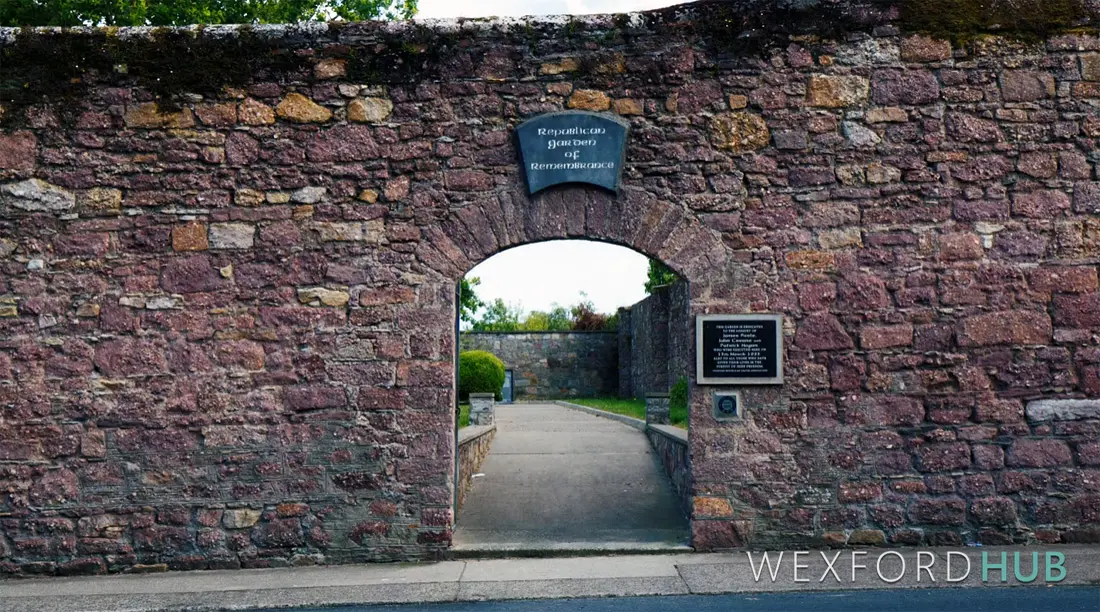
The nearby Republican Garden of Remembrance commemorates James Parle, John Creane, and Patrick Hogan, three anti-treaty IRA prisoners executed by firing squad outside Wexford Gaol on 13 March 1923. A commemorative plaque in the garden marks the exact spot where the three men were shot. An annual commemoration ceremony, organised by the Wexford branch of the National Graves’ Association, includes a parade from the Bullring to the garden.
1901 Census
The 1901 Census recorded several households on Hill Street, reflecting a mix of middle-class professionals and working-class residents.
At the first household, 55-year-old infirmary porter Thomas Hayes lived with his wife Eliza, 50, who worked as a porteress. Their three daughters, Statia, 23, Eliza, 17, and Mary, 15, worked as dressmakers. The family was Roman Catholic.
Sixty-year-old Methodist matron Amelia Windross headed the second household, residing with trained nurses Teresa Moloney (Roman Catholic) and Mary McDowell (Church of Ireland), laundress Elizabeth Murphy (Roman Catholic), domestic servants Kate Flood, Mary Anne Byrne, Bridget Murphy, and Mary Monaghan, and a visitor, Wilhelmina Wilkinson (Church of Ireland).
The third household was home to Johanna Carroll, a 35-year-old trained nurse and widow.
At the fourth household, general practitioner David Hadden, aged 54, lived with his wife Charlotte, their six children David (24, GP), Robert (22, divinity student), Ethel (19), Arthur (14, scholar), Charles (13, scholar), and Francis (12, scholar), a visitor Anna Greens (35, mother’s help, Church of Ireland), and two servants, Catherine Kelly (general domestic) and Mary Neill (domestic housemaid).
The fifth household consisted of seven Hadden children: Isabella Mary (17), Richard P (15), William H (14), Frances J (12), Eileen M (11), Marie A (9), and Addison B P (5), along with a servant, Annie Nolan (30).