On Friday, 1 May 1169, a force of Norman soldiers landed in Bannow, County Wexford. Led by Robert FitzStephen, they quickly joined another group of Normans before marching on Wexford Town. There, they besieged the town until two bishops persuaded the townspeople to surrender.
After FitzStephen secured control of Wexford, he immediately fortified the town and its surroundings by building a ringwork castle at Ferrycarrig. This castle, thought to be the first Norman fortification in Ireland, kept watch over the River Slaney.
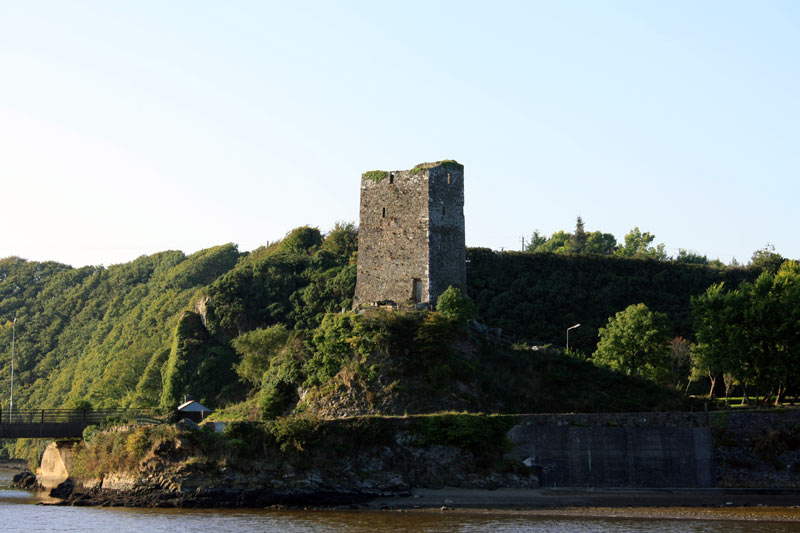
The original 1169 castle no longer exists, which leads to confusion with a 15th-century Norman tower house on the opposite side of the river. Many people mistakenly refer to the rectangular tower house on the north bank as Ferrycarrig Castle.

Many people do not realise that the ruins of the original 1169 castle lie beneath the round tower on the south bank, within the grounds of the Irish National Heritage Park.
The round tower, modelled after earlier Christian structures, was built in 1858 as a memorial for those who died in the Crimean War (1853-1856). Its distinctive medieval design leads many passersby to presume it is much older than it actually is.
In the mid-1980s, archaeologists excavated the site of the old ringwork castle. They discovered that the defensive ditch, cut from rock, measured 7 metres wide and 2 metres deep. The excavation also uncovered silver pennies from the 1200s, animal bones, pottery from France and England, a battle axe, and horse shoes.


At the time, the ferry crossing the River Slaney was vital to locals, as a bridge was not built in the area until 1795. They relied on it to transport themselves and their cattle. During the 1400s and 1500s, this three-storey tower protected the trade and traffic flowing between Enniscorthy and Wexford Town.
The tower at Ferrycarrig is one of the few tower houses in Ireland built for a military purpose. Wealthy landowners typically erected these fortifications to defend against raiders. The Ferrycarrig tower features gun loops or arrowslits, narrow slits that allowed defenders to fire on outside forces. It also has a murder hole above its doorway, which would have allowed defenders to pour scalding hot water on anyone who breached the front door.

These structures became obsolete at the end of the 1500s as artillery became more widespread. Forts such as Duncannon Fort, better suited to withstanding cannon bombardment, grew in popularity.
Location
The site has a small car park, picnic benches, and a view of the River Slaney. Visitors can climb the steep steps to the front door of the tower house, although the door is locked and caution is advised.

Map
The entrance to the car park is on the N11, between Wexford Town and Enniscorthy, just before the bridge when travelling southbound: