Rowe Street runs from Lower John Street to North Main Street in Wexford Town. It is best known as the location of the Church of the Immaculate Conception and St John, commonly called Rowe Street Church.
The street takes its name from the Rowe family, who came from England and settled at Ballycross, near Bridgetown, during the plantations. Leases on properties along the street continued in the Rowe name for generations.
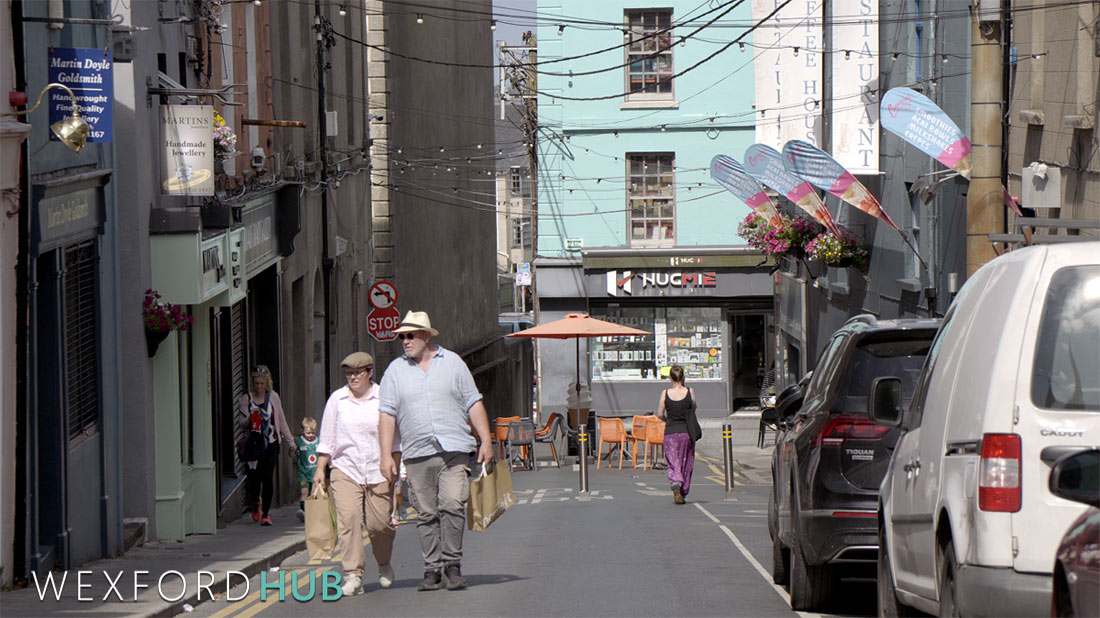
The street was created in the 19th century, when part of the old town wall was removed. It was first documented on maps around 1840.
Prior, it had been a Viking trail leading to the quay.
A surviving stretch of the old town wall and a square mural tower are visible in the Rowe Street Church car park.

Another segment of the wall remains in the grounds of the Wexford People newspaper office on Upper Rowe Street.
The street is divided into upper and lower sections. Rowe Street Upper is one-way, running from Lower John Street to the junction with High Street and Mallin Street. The lower section is two-way. However, it is shut to traffic during business hours.

Several notable buildings and landmarks line Rowe Street. One of Wexford’s “Twin Churches,” Rowe Street Church stands alongside Bride Street Church (the Church of the Assumption). Both opened in 1858, but Rowe Street Church held its first Mass on 25 April, exactly one week after its twin.

The Wesleyan Methodist Church, built in 1835 by Thomas Willis, stood on the corner of Mallin Street and Rowe Street. It closed in 1973. The funeral of Dr George Hadden is thought to have been the final religious ceremony held there.
2 Rowe Street has significant political and sporting history. The National League met there in 1884, and the Wexford County Board of the GAA was founded at the same address the following year in 1885.

Rowe Street was home to several notable residents. Charles Vize, one of Wexford’s first commercial photographers, ran the Palace Cinema from 1914 and played clarinet in its orchestra during the silent film era. He appears in the 1901 census at 13 Lower Rowe Street, recorded as a 24-year-old photographer in the household of his mother, Mary E Vize.
Mary O’Connor (1837-1927) was the first Irish female construction contractor and is thought to have built the row of terraced houses at Upper Rowe Street.
Eileen Kenny, at 7 Lower Rowe Street, was the first woman accepted to the Irish Stock Exchange. She operated out of her home office between the 1950s and early 1990s.
Census
Census data from 1901 and 1911 provides a glimpse into the street’s past.
At 13 Lower Rowe Street in 1901, Mary E. Vize (42, a housekeeper) headed a household that included her children and two elderly aunts, Anne (82) and Eliza (84) Rossiter.
Nearby, at 15 Lower Rowe Street, the Irvine family was recorded as Elizabeth M. Irvine (66, a widow and “gentlewoman”), her daughter Elizabeth A. (38), and son Harry N. (34, a stockbroker).
The 1911 census recorded Hugh McCarthy, a 48-year-old hotel keeper, at 4 Lower Rowe Street with his wife, three children, and two domestic servants.
Map
A map showing its location: