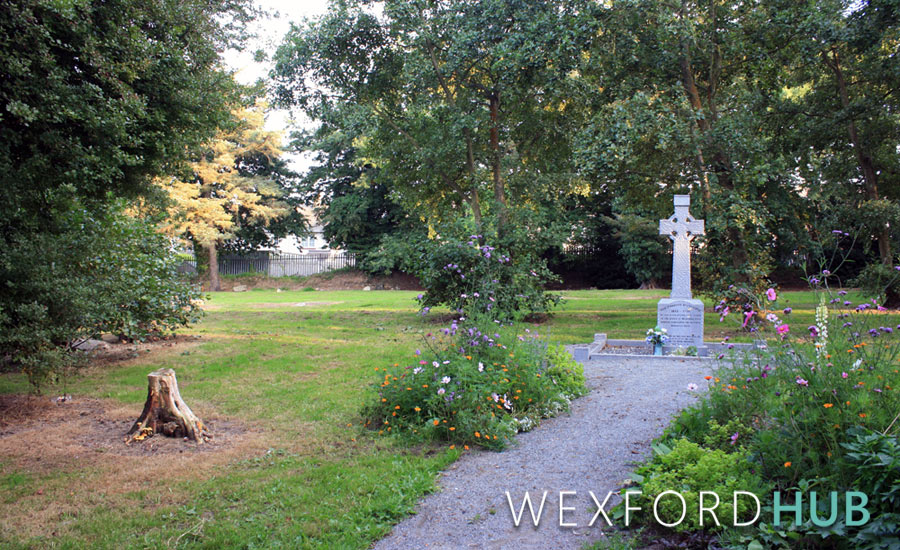
The Paupers’ graveyard is a burial ground in Coolcotts Lane in Wexford Town. It was established in the early 1850s as a cemetery for the Wexford Union Workhouse and served as the final resting place for the poor and destitute who died within its walls.
Between approximately 1853 and 1939, thousands of unnamed paupers were laid to rest in unmarked mass graves on the one-acre site. Among them were 27 victims of the 1859 Pomona emigrant shipwreck that sank off Blackwater.
Famine
The origins of the graveyard lie in the impact of the Great Famine and a prolonged agricultural depression that left many working-class families destitute. As conditions worsened, increasing numbers of people sought refuge in the workhouse.
Records from late 1851 routinely showed weekly inmate populations exceeding 1,520 people.
The overcrowding created deadly conditions. Officers reported that between 1848 and 1853, more than 1,700 deaths occurred within the workhouse walls alone, many caused by “dangerous epidemics.” They noted that they were constantly “exposed to imminent risks of falling victims to contagious diseases.” Within a short period, two workhouse masters died after contracting fever.
Wexford’s graveyards were running out of space
Before the Union graveyard opened, several burial grounds had served the town. These included St Michael’s in The Faythe, St Mary’s, St Peter’s, and a burial ground on the present site of the Church of the Assumption, which had reportedly been “disused longer than any person could remember.”
However, by the mid-1800s, these small cemeteries had become overcrowded. Faced with hundreds of bodies and no available space within the town parishes, the workhouse urgently needed to acquire a plot of its own.
The need for a dedicated burial ground led the Wexford Corporation and the Board of Guardians to take action.
In 1850, the council instructed the town clerk to seek permission from the Treasury to sell an acre of land at Coolcotts to the workhouse for use as a cemetery.
Because the land was being leased to Patrick Frayne as part of a larger three-and-a-quarter-acre plot, the corporation had to request Frayne’s surrender of his interest before the acre could be sold.
By March 1853, the site was being enclosed and prepared as the “new cemetery.” During one inspection, the master of the workhouse reported that the gate piers did “not stand perpendicular” and required straightening before a gate could be hung.
Burials
The burial practices reflected the constant pressure of mortality. Bodies were wrapped in unbleached calico shrouds and placed in reusable slip coffins with hinged bottoms that released the bodies directly into mass graves. Fellow workhouse inmates, themselves weakened by disease and deprivation, dug the graves.
Historian Nicholas Furlong later recalled that many of the graves were dug only a few inches below the surface. In some cases, families placed large stones to mark where their relatives lay.
The weekly accounts of the master regularly listed coffin orders alongside provisions, often distinguishing between coffins for adults, older children, and infants, a stark indication that child mortality formed a routine part of the workhouse death toll.
Demand was so constant that the Board of Guardians put the supply contract out to tender on a twelve-month basis. One accepted tender from Francis P. Howlin set prices at 4 shillings and 8 pence for large coffins, 3 shillings and 8 pence for small coffins, and 1 shilling and 3 pence for infants’ coffins.
Later developments
The graveyard became the subject of a local controversy in 1876, when the Dublin, Wicklow, and Wexford Railway Company petitioned against the Wexford Waterworks Bill. The corporation responded by attacking the quality of the company’s water source, declaring that “the water procured by the Railway Company” was “unfit for domestic use” because the stream originated in the neighbourhood of the Wexford Union graveyard.
In 1884, workers removed two rows of trees from the site to create additional grave space and allow for vehicle access. In 1886, concerns were raised about cattle, with a local councillor noting that the graveyard was “very much trespassed by cattle.”
Restoration
When historian Nicholas Furlong first discovered the graveyard around 1965, it was “a desolate landscape in the heart of the countryside with nothing but a cement cross.” He described it as the final resting place of “the more wretched, the more downcast and the most abandoned members of our community” and mentioned plans to renovate it as an amenity of contemplation.
By the late twentieth century, the graveyard had again fallen into neglect and become overgrown. In 1990, Wexford town councillor Padge Reck and community activist Ray Nolan initiated a restoration project, erecting a Celtic cross bearing the inscription: “In this place, known only to God, lie the bodies of Wexford’s poor, deprived, handicapped, and destitute. Remember them.”
The first annual patron ceremony was held the same year.
Reck and Nolan later founded the Wexford Memorial Trust, which continues to maintain the graveyard and organise the annual commemoration.
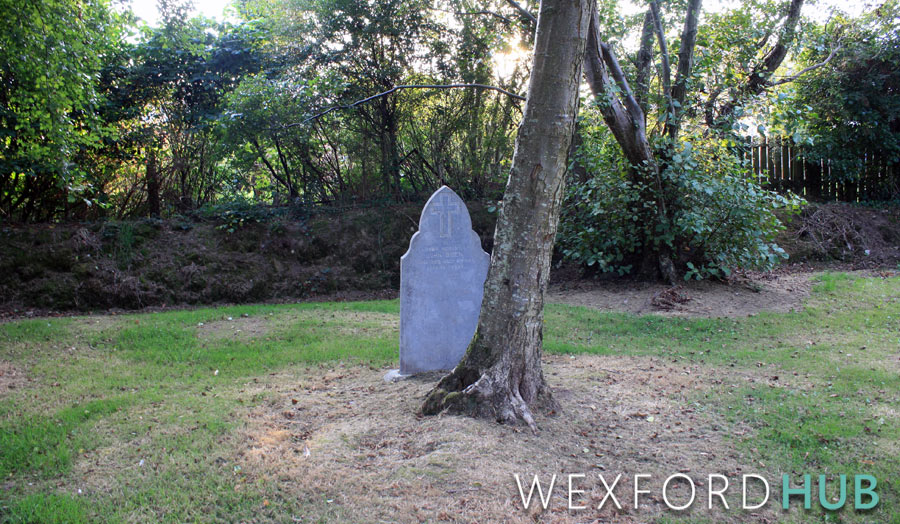
A plaque on the boundary wall commemorates a woman named Sarah Higginbotham and her infant son Thomas, who both died in 1886. Their resting place was identified through the efforts of Higginbotham’s great-great-grandson.
A memorial commemorating the 27 victims of the 1859 Pomona shipwreck buried in the graveyard was unveiled at the site on 14 June 2024.
All information sourced from newspaper archives and minutes of meetings from the Wexford Corporation, Wexford Union Workhouse, and Wexford County Council.
Map
A map showing its location: