The Norse-Irish town of Wexford underwent many changes in the 12th century.
In 1169, a Norman force that had landed in Bannow Bay besieged the town. The small army, led by Robert Fitz-Stephen and the recently deposed King of Leinster, Diarmait Mac Murchada, took control of Wexford after two bishops advised its inhabitants to surrender.
In the years that followed, a wave of Norman influence began to alter the fabric of the town.
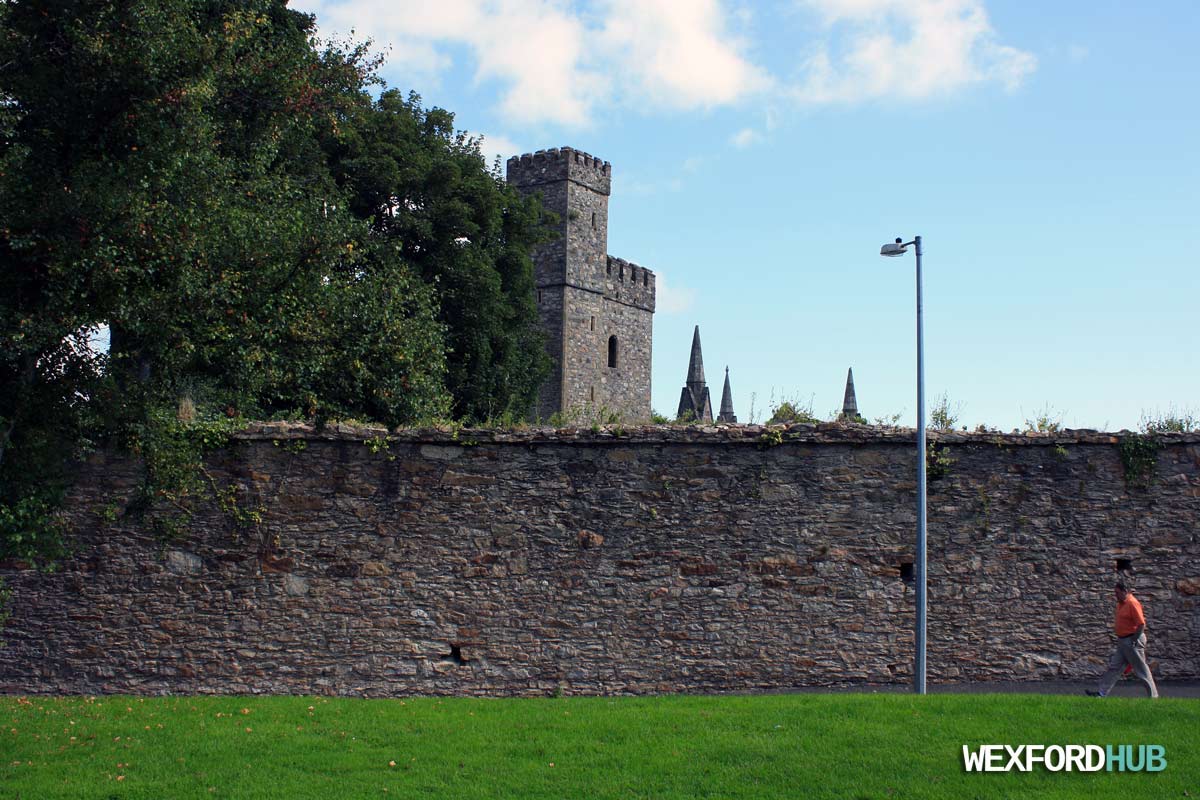
One of the most striking additions to Wexford during this period was the construction of a large stone wall, which looped around the town in the shape of a C, running from West Gate and Selskar Abbey to the site of Wexford Castle in Barrack Street.
The wall enclosed an area of approximately 25 hectares.
Town wall map

The red dots on the map pinpoint the locations of the six town gates:
- West Gate (also known as Cow Gate): Demolished. Located in Westgate, near Redmond Square. It provided access to the west of the county.
- John’s Gate: Located on John’s Gate Street, near the library.
- Kayser’s Gate: Situated on Mary Street, near The Friary, at the narrow street that leads down to High Street. In later times, it was sometimes referred to as Friar’s Gate or Raby’s Gate.
- Peter’s Gate: Stood at the entrance to St. Peter’s Square, at the top of Peter Street.
- Bride Gate: Ran across Bride Street, just around the corner from the existing public car park.
- Castle Gate: Located on Barrack Street, next to Wexford Castle.
A surviving gate tower near Selskar Abbey, sometimes referred to as Selskar Gate or West Gate Tower, was a private gate into the abbey rather than a town gate.
Traffic growth led to the first dismantling of the gates in 1759. After 1798 they were re-erected in a less substantial form and remained in place until 1835, when the remaining four were finally removed.
The darkened part of the map that is labelled “Reclaimed Land” marks the area of Wexford’s shoreline that was reclaimed in later years. When the town wall was first built, the waters of the harbour came in much further than they do today. In those days, places such as Redmond Square and the Crescent Quay were part of the harbour. The harbour waters extended so far inland that Temperance Row outside Selskar Abbey was used as a loading bay for sheep, hence its former name, the Hai Bay.
Mural towers
There are three publicly viewable mural towers, which would have allowed the inhabitants of Wexford to defend large stretches of the wall.

These mural towers had narrow slit windows and battlements at the top. Earlier-built versions were rectangular, while towers from the 13th century onward tended to be more cylindrical.

The existence of both styles of mural towers has led many to believe that the wall was built over a lengthy period.
Construction and upkeep
The section of the wall that runs from Abbey Street to Selskar Abbey is still standing, which suggests that it was built at a later date.
The cylindrical mural towers reinforce this theory. Many parts of the southern section of the wall, from High Street to Barrack Street, failed to survive, likely due to the damper marshy ground on which it was built.
It is presumed that construction of the wall began in the early 1200s. Based on the time taken to build similar walls elsewhere in Ireland, construction likely took roughly 50 years.

The wall around Wexford likely needed ongoing maintenance. References to toll collections for “the repair of the town’s defences” during the 1300s lend credence to this. During the 1500s, the Mayor of Wexford felt that the walls were in such a bad condition that they had effectively left the town defenceless. He asked for a rent amnesty, with the idea that the rent money could be directed towards repair work.
The cost of maintaining the walls appears to have created a divide between the northern and southern halves of the town, both of which were responsible for maintaining their respective sections. During a court hearing in the 1400s, the court heard that the south side of Wexford was able to generate more revenue than the northern half. The court ruled that both sides should combine their revenue and that maintenance work should be carried out without preference for north or south.
In recent years, the wall in Abbey Street was preserved and repaired using lime mortar instead of cement. Such structures are not restored to their original state because doing so may confuse or impede study by future generations. For historical structures, preservation is favoured over restoration.