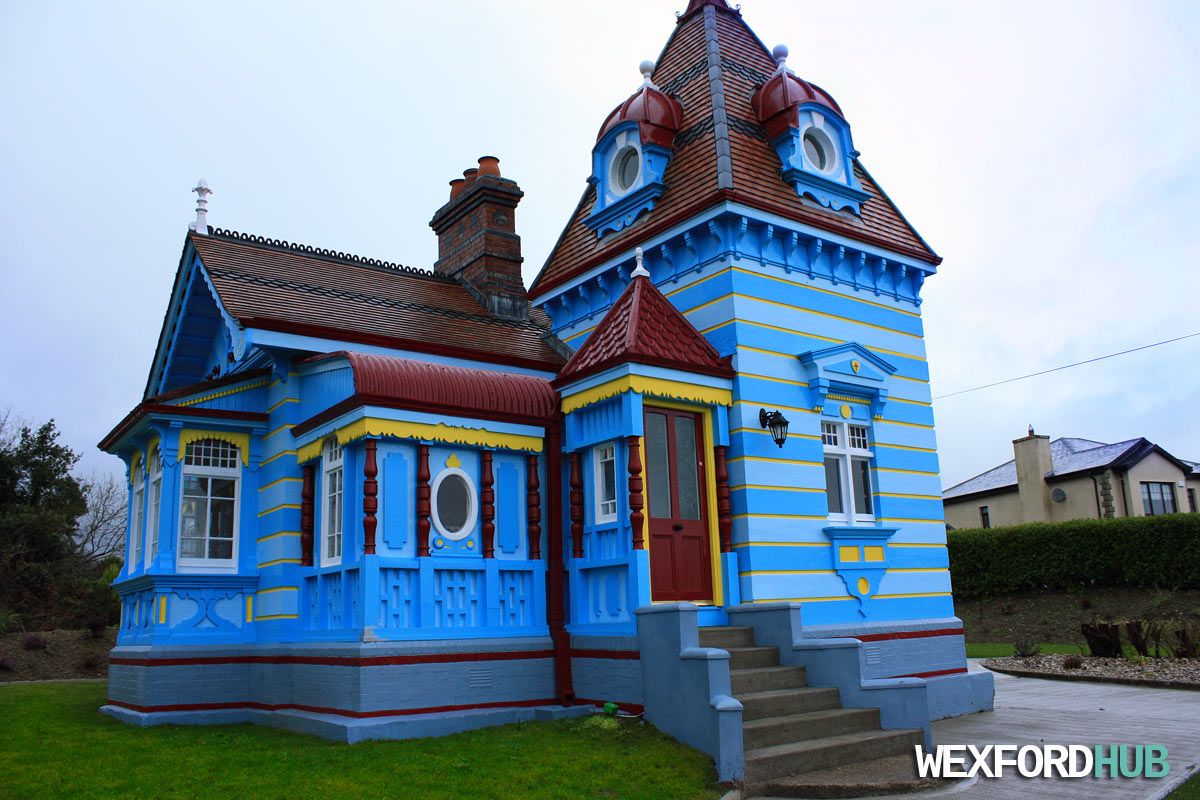
The Doll’s House is a brightly painted gate lodge at the entrance to Rathaspeck Manor in County Wexford. The single-storey cottage is known for its compact size, chalet-style design, and striking blue exterior.
Built between 1680 and 1720 by the Codd family, Rathaspeck Manor is a Georgian-style country house now owned by the Cuddihy family. The estate is approximately five minutes from Wexford Town.
The Doll’s House dates from 1900, when an English family named the Moodys built it as a gate lodge for the manor. Despite its purpose, many locals believed it was a doll’s house for the owner’s daughter. The Cuddihy family, who have owned the manor for generations, have never called it the Doll’s House, referring to it only as “the Chalet.”

The gate lodge was listed as a protected structure in 2001. Until the early 2000s, the house had fallen into disrepair, with its roof needing repair and its once-bright colour scheme faded. A grant from The Heritage Council funded the re-roofing of the lodge in 2004. Denis Frayne Limited, a construction company specialising in the restoration of old buildings, repainted and restored the Doll’s House in 2014, with a grant from Wexford County Council partly funding the work.
The interior has also been restored and contains a sitting room, two downstairs bedrooms, a front and back porch, a large kitchen extension, and a loft bedroom in the turret. Since June 2017, the property has operated as a self-catering holiday rental, bookable through Airbnb.

Beyond its unusual history, the building’s distinctive design has also been a subject of debate. Its origin is uncertain. One theory holds that it came from the Exposition Universelle, a world’s fair held in Paris in 1900. The fair displayed various architectural structures, machines, and inventions, including the diesel engine and the escalator. Conservation architects note that the front hallway measures exactly one metre. This, they argue, suggests that the building was constructed using the French metric system and shipped from the exposition to Ireland, where it was reconstructed at the gates of the manor. Architectural historian JAK (Dixie) Dean proposed an alternative theory: the house may have been constructed locally using mail-order plans, as the builder, Edmund Moody, owned a sawmill.
Map
A map showing its location: